If you have searched for short-term rental rules on the Monterey Peninsula recently, you have probably noticed the answers change depending on who you ask, and depending on when you ask. Between 2022 and now, Monterey County rewrote its vacation rental ordinance twice, fought a lawsuit over it, got the California Coastal Commission to certify it, lost part of it in court, and is still being sued as of this writing. Individual cities have their own separate rules layered on top of that.
We have consolidated all of it here, jurisdiction by jurisdiction, because nobody else has.
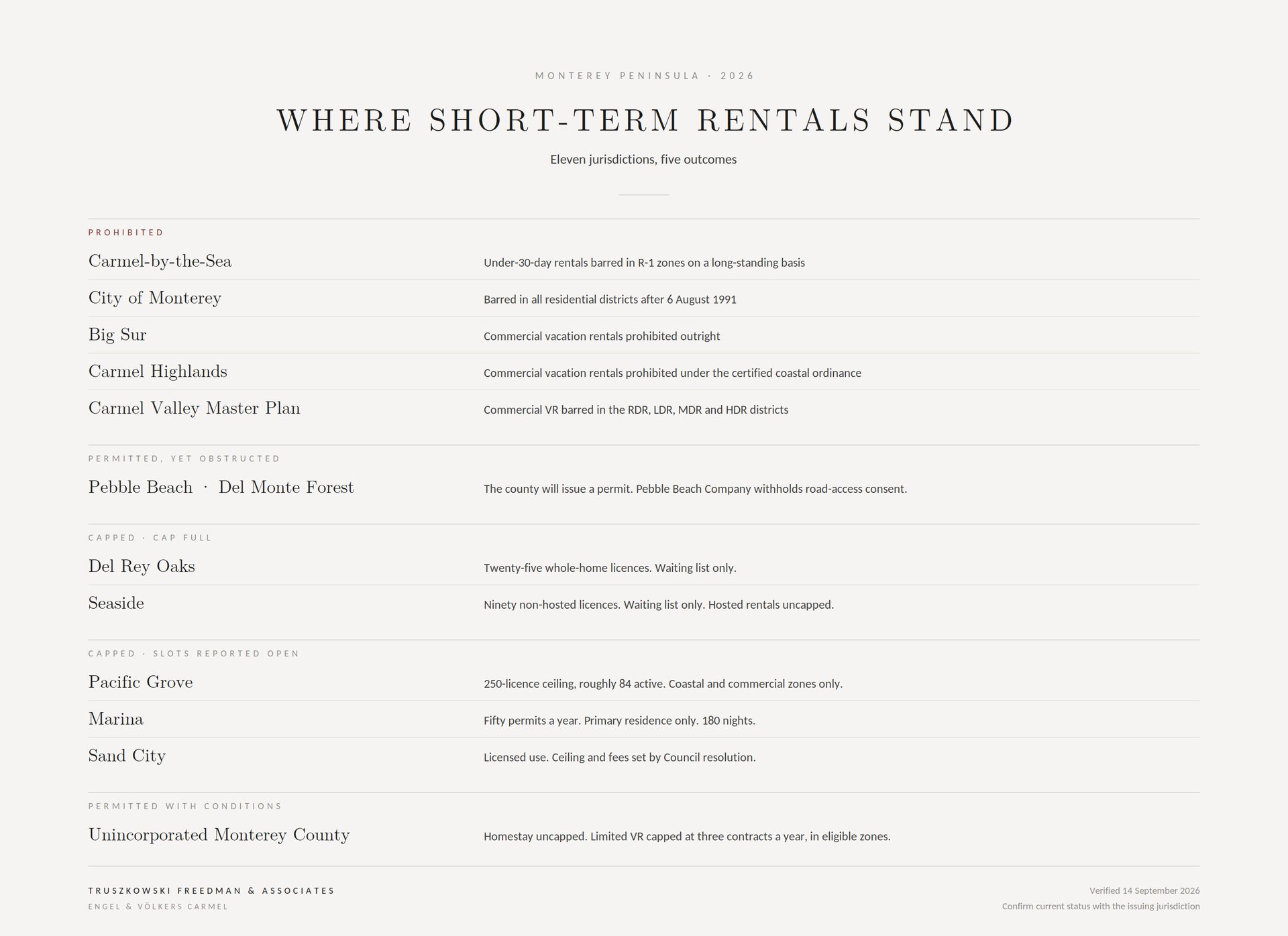
Short-term rentals are effectively banned in Carmel-by-the-Sea's residential zones and across the City of Monterey. In unincorporated Monterey County, which covers Carmel Valley, Big Sur, Carmel Highlands and Del Monte Forest, Homestays and Limited Vacation Rentals are allowed, while Commercial Vacation Rentals are capped near 4% of housing stock and banned outright in Big Sur, Carmel Highlands and Carmel Valley's residential districts. Pacific Grove, Marina and Sand City run capped licensing programs with slots open. Del Rey Oaks and Seaside are capped and currently full. Pebble Beach is the outlier: the county will issue a permit, but the Pebble Beach Company withholds the private road-access consent it says its CC&Rs require.
One caution before you rely on any of it. Short-term rental law here is genuinely unsettled and litigation is active in several places. The figures below are accurate as of our publish date. Confirm current fees, caps and permit status directly with the relevant city or county office before you apply for anything, and before you make a purchase decision based on rental income. We have linked our sources throughout.
Quick reference
- Carmel-by-the-Sea
- Monterey County framework
- Pebble Beach
- Carmel Valley
- Big Sur
- Carmel Highlands
- City of Monterey
- Pacific Grove
- Marina
- Del Rey Oaks
- Seaside
- Sand City
- Tax rates
- Long-term rentals
- FAQ
What Counts as A Short-Term Rental Here
Three terms do most of the work in this article, and jurisdictions use them consistently enough that they are worth learning once.
Short-term rental, also called a vacation rental. A rental of a residential unit for stays of less than 30 consecutive days, unhosted, meaning the owner is not present.
Homestay, also called a hosted rental. The owner or a resident manager lives on site and rents out a room or a portion of the home while present.
Long-term rental. A lease of 30 days or longer. This is what triggers standard California landlord-tenant law rather than transient occupancy rules.
One exception worth flagging now, because it catches people: Marina draws its line at 29 consecutive days rather than 30. A 30-night booking in Marina is already a long-term rental for code purposes. Everywhere else on this list, the threshold is 30.
One Rule that Applies Everywhere a Permit Is Capped
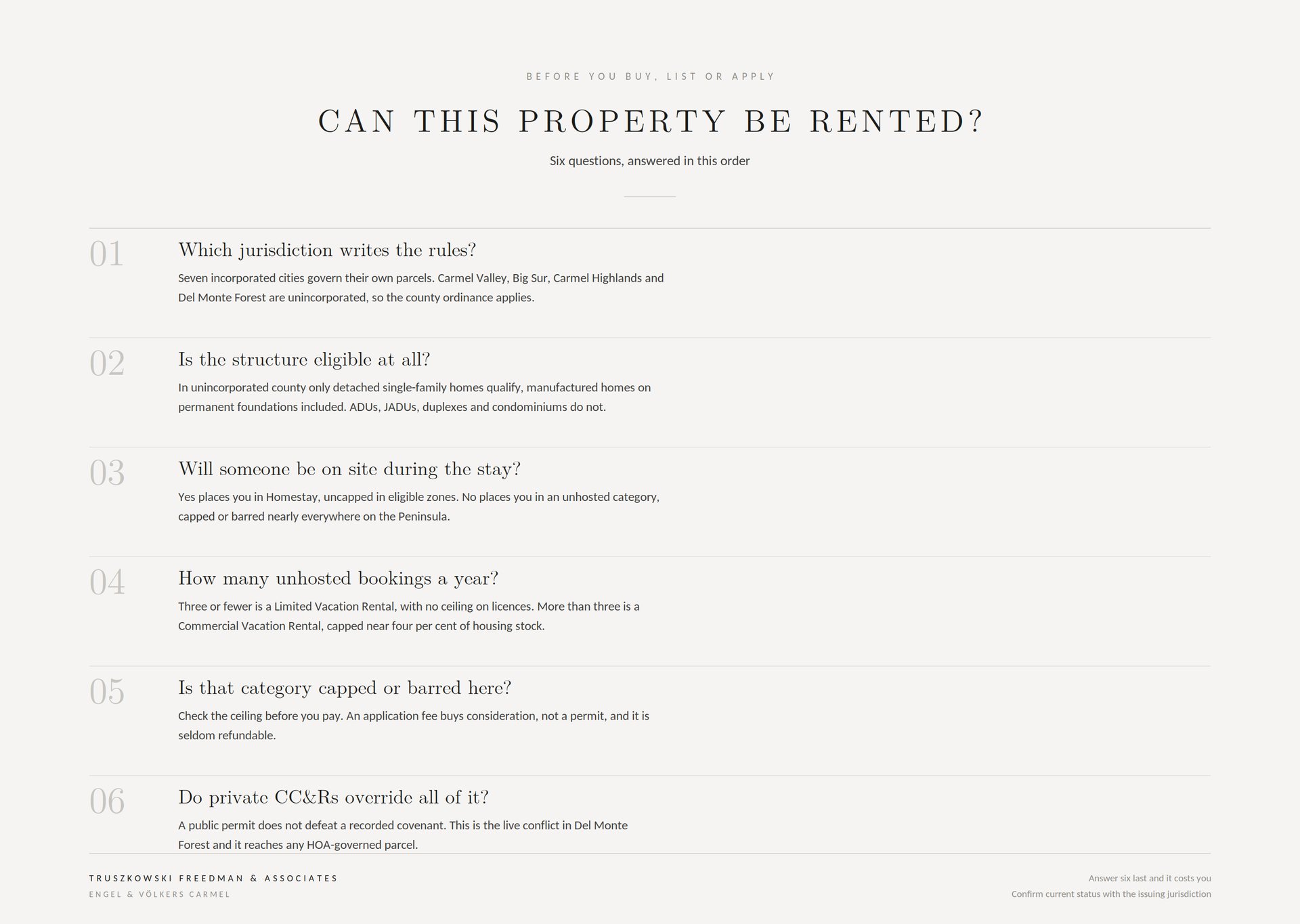
This applies in Pacific Grove, Del Rey Oaks, Seaside, Marina, and to Commercial Vacation Rentals in unincorporated Monterey County. Paying the application fee gets your application considered, not approved. If the cap for your zone or planning area is already full, your application can be rejected or placed on a waiting list after you have paid, and application fees are typically non-refundable either way.
Check current cap status before you apply. This is the single most common way owners waste money on this process.
Quick Reference: All 11 Jurisdictions
| Area | Jurisdiction | STR status | Key restriction |
| Carmel-by-the-Sea | City | Banned in single-family (R-1) zones | Legal only via pre-2019 nonconforming permits or new affordable-housing-linked permits in commercial and R-4 districts |
| Carmel (unincorporated) & Carmel Highlands | Monterey County | Homestay and Limited VR allowed; Commercial VR banned in the Carmel Highlands coastal zone | County vacation rental ordinance, 4% cap where allowed |
| Carmel Valley | Monterey County | Homestay and Limited VR allowed; Commercial VR banned in Master Plan residential zones | County ordinance |
| Monterey (city) | City | Effectively banned in residential districts | Only pre-August 1991 grandfathered units remain, on a sunset timeline |
| Pacific Grove | City | Allowed, capped | 250 citywide STR license cap; coastal and commercial zones only |
| Big Sur | Monterey County | Commercial VR banned; Homestay and Limited VR allowed | Big Sur Coast Land Use Plan plus the Coastal Commission-certified ordinance |
| Pebble Beach / Del Monte Forest | Monterey County | Legally permitted for qualifying properties, but Pebble Beach Company is refusing consent | County permit does not equal PBC road-access consent; active conflict |
| Marina | City | Allowed, capped | 50 permits per year, owner-occupied primary residence only, 180 nights per year maximum |
| Del Rey Oaks | City | Allowed, capped, currently full | 25 whole-home license cap, waitlist only |
| Seaside | City | Hosted allowed uncapped; non-hosted capped and currently full | 90-license cap on non-hosted rentals, waitlist only |
| Sand City | City | Allowed, licensed | Cap and fees set by City Council resolution, not fixed in code |
Marina, Del Rey Oaks, Seaside and Sand City sit just outside the traditional Monterey Peninsula footprint. We have included them because they come up in the same conversation constantly.
Can you short-term rent in Carmel-by-the-Sea?
No, not in single-family residential zones.
Carmel-by-the-Sea is its own city, separate from the county rules described further down, and it takes the strictest line of any jurisdiction on this list.
Single-family (R-1) residential zones. Rentals under 30 consecutive days have been prohibited on a long-standing basis. Multiple sources trace this residential ban back to 1989. This is not a recent change and it is not under active reconsideration.
Commercial and R-4 districts. Transient rentals are allowed only under two narrow permit types. The city closed the door on new commercial-district permits with a December 3, 2019 ordinance, 2019-03, passed 3 to 0, which froze the category and grandfathered what already existed.
- Legal Nonconforming Permits. These existed as of the December 2019 ordinance. They are non-expiring, allowed to remain in place indefinitely per the city's own framing, and transferable with the property. They cannot relocate to a new address.
- Housing Incentive Permits. New permits tied to affordable housing creation. A developer or owner must create three new rental units, two at low or moderate income and one at market rate, to earn one transient rental permit, subject to a conditional use permit.
Other requirements. One off-street parking space per unit is required for licensed transient rentals. Advertising an unpermitted transient rental is itself a separate code violation under CMC 17.28.040, enforced by Code Compliance.
Taxes. Transient occupancy tax in Carmel-by-the-Sea is 10%, filed bi-monthly, on top of a required business license and a Transient Occupancy Registration Certificate for any permitted property.
Enforcement. Largely complaint-driven, meaning neighbors reporting suspected unlicensed rentals. Penalties can run up to roughly $1,000 per violation per day for unlicensed operation.
The practical takeaway. Unless you own one of the small number of grandfathered or specifically permitted commercial-district properties, a home inside Carmel-by-the-Sea city limits cannot legally be rented for under 30 days. If you are evaluating a purchase here on the assumption of nightly rental income, that assumption does not survive contact with the code. See our Carmel-by-the-Sea listings and neighborhood guide.
How Monterey County's Vacation Rental Ordinance works
This framework governs Carmel Valley, Big Sur, Carmel Highlands, unincorporated Carmel and Del Monte Forest. It touches more of the Peninsula than any single city ordinance, so it is worth understanding before reading those sections.
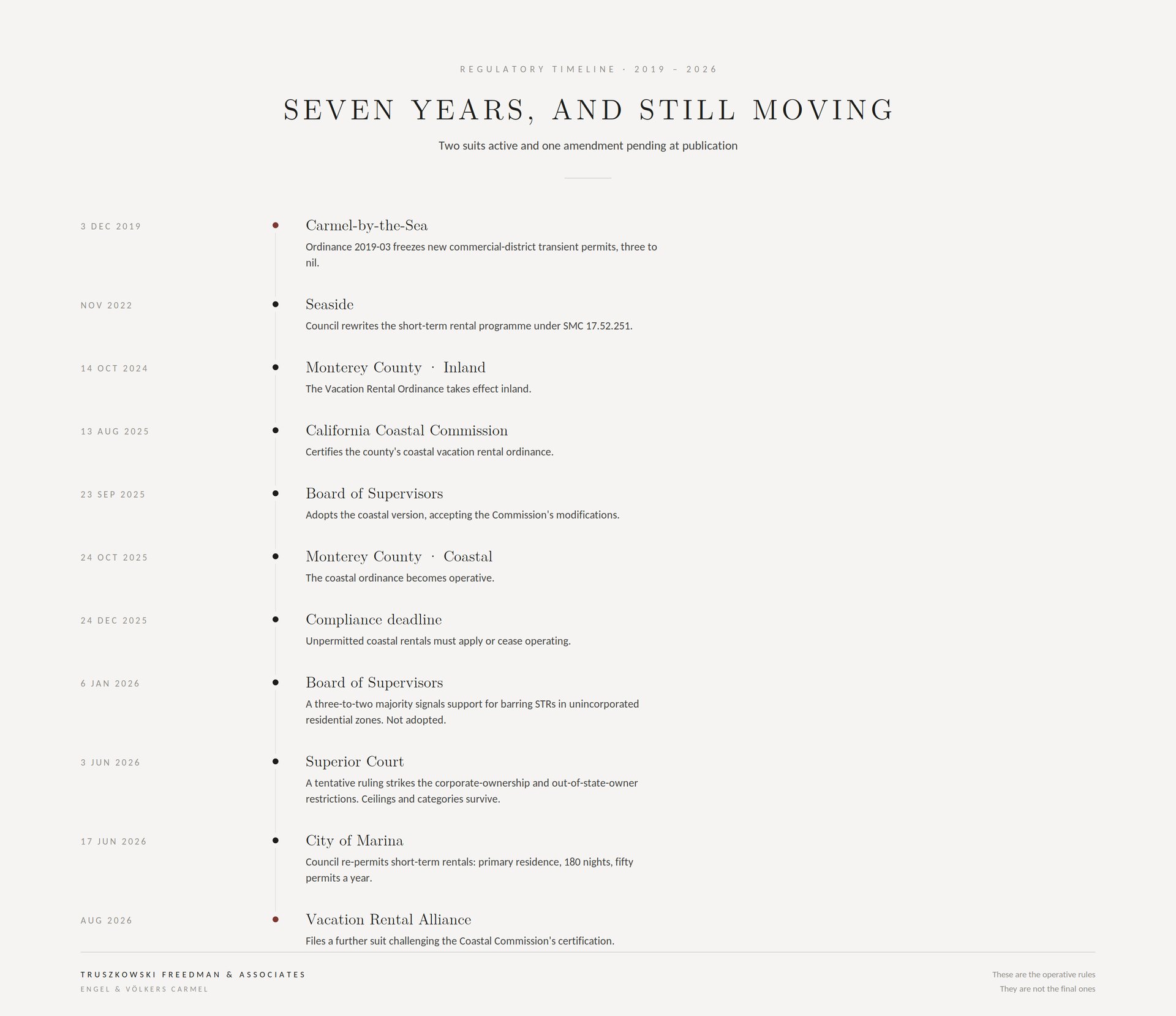
Monterey County finalized its long-promised Vacation Rental Ordinance in two phases. The inland version became effective October 14, 2024. The coastal zone version was certified by the California Coastal Commission on August 13, 2025, and the Board of Supervisors adopted the certified version, accepting the Commission's modifications, on September 23, 2025. It became operative October 24, 2025. Owners with existing unpermitted coastal rentals had until December 24, 2025 to apply for a permit or stop operating.
The Three License Categories
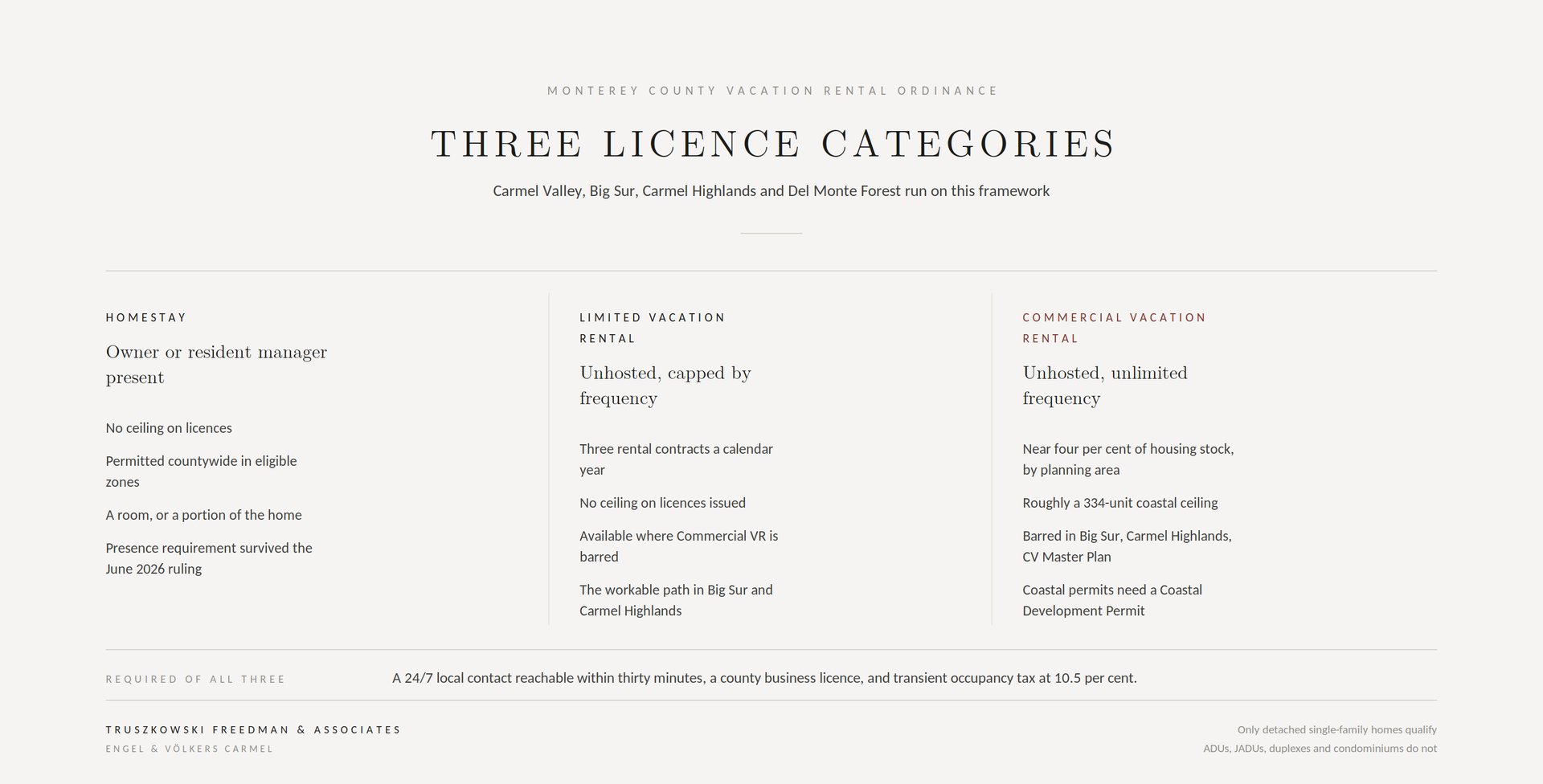
Homestay. The owner or resident is present during the rental. No cap on licenses, allowed countywide in eligible zones.
Limited Vacation Rental (LVR). Unhosted, but capped at three rental contracts per calendar year. There is no cap on the number of these licenses issued.
Commercial Vacation Rental (CVR). Unhosted, unlimited rental frequency. Capped at roughly 4% of the housing stock in each Planning Area, with inland and coastal caps calculated separately. This has been reported as a 334-unit total ceiling on commercial short-term rentals across the entire coastal zone, allocated by community. This is also the category subject to outright bans in several specific places, covered below.
The distinction that matters most to owners: if you can live with three bookings a year, the Limited Vacation Rental category is available to you in places where the Commercial category is flatly prohibited. That is the difference between owning a property you can occasionally rent and owning one you cannot rent at all.
What a Vacation Rental Permit Actually Costs
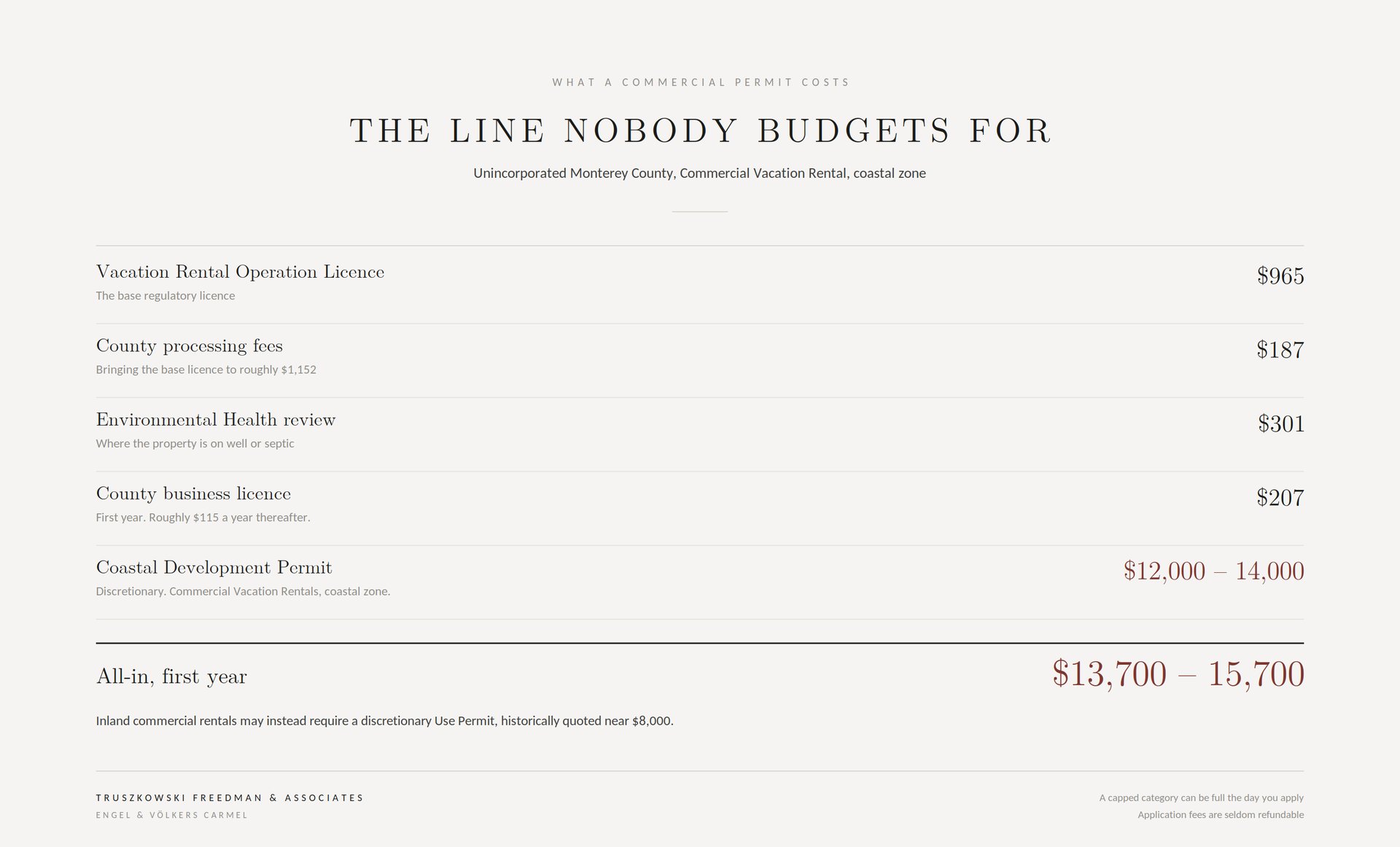
Vacation Rental Operation License, the base regulatory license: $965, roughly $1,152 with county processing fees.
Environmental Health review: add $301 if the property is on a well or septic system.
Coastal Development Permit: Commercial Vacation Rentals in the coastal zone additionally require a discretionary Coastal Development Permit, which realistically runs around $12,000 to $14,000 given county planning fee schedules. This is a separate and much larger cost from the base license, and it is the line item most owners do not budget for.
Use Permit: inland Commercial rentals may similarly require a discretionary Use Permit, historically quoted around $8,000.
County business license: also required, roughly $207 the first year and $115 annually.
Standing Operating Rules for Every Category
Only detached single-family homes qualify, including mobile and manufactured homes on permanent foundations. ADUs, JADUs, duplexes and condominiums are not eligible for short-term rental use.
Owners must maintain a 24/7 local contact reachable within 30 minutes.
Transient occupancy tax for unincorporated Monterey County is 10.5%, remitted to the County Tax Collector.
Ownership was originally restricted to individuals and trusts, with no LLCs or out-of-state owners. A June 3, 2026 tentative court ruling struck down the corporate-ownership and out-of-state-owner restrictions as unconstitutional under the Commerce Clause. The 4% caps, the three-category structure and the homestay presence requirement all remain in force.
What Is Still in Litigation
On January 6, 2026, a 3 to 2 majority of the Board of Supervisors signaled support for banning short-term rentals outright in unincorporated residential zones, with commercial and agricultural zones still allowing them. This was framed as a defensive move against ongoing litigation from the Monterey County Vacation Rental Alliance. It has not been adopted as final ordinance language as of this writing.
The Alliance has since filed an additional suit, in August 2026, challenging the Coastal Commission's approval itself.
In plain English: the rules described here are the current operative rules, but this area is genuinely in flux. Double-check before applying for a permit or budgeting on rental income.
Can You Short-Term Rent in Pebble Beach and Del Monte Forest?
Legally, yes. Practically, often no. This is the messiest situation on the Peninsula right now and it deserves careful reading.
The county's ordinance treats Del Monte Forest like any other coastal Planning Area. Homestays and Limited Vacation Rentals are allowed, and Commercial Vacation Rental permits are available up to the 4% cap, subject to a Land Use Permit from the county and a TOT certificate.
However, the Pebble Beach Company takes the position that its private CC&Rs prohibit short-term and commercial use of homes in Del Monte Forest, and the Company controls access via the private roads throughout the community. It has been refusing to grant the road-access consent it says those CC&Rs require, which effectively blocks new short-term rental operators even after they have secured a county permit.
The county's position is that CC&R enforcement is a private civil matter outside its jurisdiction. It will still issue permits. It simply will not referee the dispute that follows.
In practice, some owners are operating anyway without the Company's blessing, and multiple permit applications are under appeal to the Board of Supervisors.
What this means if you are buying here. Do not assume the Pebble Beach Company or its sales and marketing arms have accurate short-term rental information. Go to Monterey County HCD for the permit question, and separately to the Company for its consent requirements. Get both answers in writing before you write an offer that depends on rental income. A county permit is not the finish line in Del Monte Forest. See our Pebble Beach listings and neighborhood guide.
Can You Short-Term Rent in Carmel Valley?
Partially. Commercial Vacation Rentals are banned within the Carmel Valley Master Plan's residential zoning districts, which are RDR, LDR, MDR and HDR. Homestays and Limited Vacation Rentals of three or fewer contracts per year remain available where zoning otherwise allows.
Carmel Valley is unincorporated Monterey County, so the county framework described above governs. There is no separate city code here. See our Carmel Valley listings and neighborhood guide.
Can You Short-Term Rent in Big Sur?
Not commercially. Commercial Vacation Rentals are prohibited outright along the Big Sur coast, consistent with the long-standing Big Sur Coast Land Use Plan, which has never recognized short-term rentals as a principal residential use.
Homestays and Limited Vacation Rentals are still permitted.
As of August 2026, this prohibition remains in effect even amid the Monterey County Vacation Rental Alliance's newest lawsuit against the Coastal Commission's certification. A court would have to intervene to change it.
See our Carmel Highlands and Big Sur listings and neighborhood guide.
Can You Short-Term Rent in Carmel Highlands and Unincorporated Carmel?
Not commercially. Commercial Vacation Rentals are prohibited in Carmel Highlands under the certified coastal ordinance, the same treatment Big Sur receives.
The Homestay and Limited Vacation Rental categories remain available.
Note that Carmel Highlands and unincorporated Carmel are distinct from Carmel-by-the-Sea. They are county jurisdiction, not city, and the rules are entirely different. The address on the deed will not always make this obvious. Confirm which side of the city limit a property sits on before assuming either set of rules applies.
Can You Short-Term Rent in The City of Monterey?
No. Monterey has taken the hardest line of any Peninsula jurisdiction.
Short-term residential rentals are prohibited in all residential districts for any rental established after August 6, 1991. The city's own framing is that short-term rentals are banned everywhere except property specifically zoned Visitor Accommodation Facilities, meaning hotel, motel and resort-designated parcels. There is no path to a legal whole-home short-term rental in an ordinary residential zone.
A narrow grandfather clause allowed pre-1991 operators to continue, but only if they registered with the city's Finance Department within 60 days of the ordinance's effective date and provided proof of prior operation. Even then, those grandfathered rentals were required to sunset within five years of the ordinance, or immediately upon sale of the property, whichever came first. That window closed years ago.
The city separately prohibits advertising a short-term rental that is illegal under the municipal code, under section 22-19.5. Each day a listing stays up is treated as a separate violation, though the hosting platforms themselves are not liable as responsible parties.
Monterey has pursued this aggressively. It has taken short-term rental cases to court multiple times since 2014 and has won each one, and it actively monitors listing sites for unpermitted rentals.
Taxes. Transient occupancy tax in the City of Monterey is 12%. Lodging near the Monterey Conference Center may also owe a Conference Center Facilities District assessment of 0.8% to 4.15% depending on proximity and service level, plus a Tourism Improvement District per-night fee.
The practical takeaway. If you are buying in the City of Monterey specifically for short-term rental income, do not. It is not a legal use in residential zones, with vanishingly few historic exceptions, and the city is unusually willing to litigate.
Can You Short-Term Rent in Pacific Grove?
Yes, if you can get a license. Pacific Grove remains the most short-term-rental-friendly incorporated city on this list, but it runs a capped, licensed system rather than an open one.
Short-Term Rental License. For renting an entire dwelling unit for stays under 30 days. Only allowed in Coastal and Commercial zones, not in general residential zones.
Home Sharing License. For renting a room or rooms within an owner-occupied home while the owner is present. Allowed citywide, with no zone restriction and no cap.
Citywide cap. 250 total short-term rental licenses. As of our last check, roughly 84 were active, well under the cap, though that number moves.
Zoning restriction. One short-term rental license per parcel, plus a required 55-foot zone of exclusion from any other licensed short-term rental parcel. This is an intentional density limiter and it is the rule most likely to disqualify an otherwise-eligible property.
Occupancy. Short-term rental maximum is two guests per bedroom plus one additional person on site. Home Sharing tops out at two adults per bedroom, with children permitted under the same rental contract.
Fees. Short-term rental license: $141 non-refundable application fee, $124 issuance fee, $221 annual renewal. Home Sharing: $81 application fee, $265 annual license fee, prorated quarterly.
Taxes. Transient occupancy tax is 12%, filed monthly and due the 15th of the following month. Airbnb remits automatically. Other platforms require the host to file directly.
Penalties. Unlicensed operation is subject to fines of at least 60% of total revenue earned through the illegal rental, accruing daily, and violators are barred from obtaining a license for two years. That penalty structure is more aggressive than it first appears, because it is calculated on revenue rather than as a flat fine.
See our Pacific Grove listings and neighborhood guide.
Can You Short-Term Rent in Marina?
Yes, with tight conditions, and only if the property is your primary residence.
Marina banned short-term rentals for a period and then rewrote its ordinance to allow them again with tighter rules. The current version dates to a June 2026 City Council update.
Eligible properties. Single-family dwellings and duplexes only, and only as the owner's primary residence, verified with two forms of ID at application. Non-owner-occupied rentals, condominiums, deed-restricted and below-market-rate units, and properties with an ADU or JADU are excluded, unless that accessory unit was approved before January 1, 2020.
Citywide cap. Reported at 50 short-term rental permits issued per year.
Annual night limit. A permitted property can be used as a short-term rental for a maximum of 180 calendar nights per year. Beyond that, it must revert to standard residential use for the remainder of the year.
Stay length. Marina draws its line at 29 consecutive days or fewer, not the 30-day threshold used by the county and every other city in this post. A 30-day booking in Marina is already a long-term rental for code purposes.
Zone of exclusion. One report puts this at a 55-foot separation requirement from any other permitted short-term rental, similar to Pacific Grove's rule. We could not independently confirm this figure on the city's own site.
Guest limits. Two guests for a studio, four for one bedroom, six for two bedrooms, eight for three, ten for four, capped at twelve regardless of bedroom count.
Fees. The city's own current page lists a $950 application fee and $125 annual renewal, with permits expiring every June 30. A secondary source quoted lower figures, roughly $160 and $115, which may reflect an older fee schedule. Confirm current pricing directly with Marina's Planning Division at 831-884-1220 before budgeting.
Taxes. Transient occupancy tax is 14%, the highest on this list, collected monthly and remitted through the city's HdL portal.
Can You Short-Term Rent in Del Rey Oaks?
Not right now, for whole-home rentals. The city caps Whole-Home, meaning unhosted, short-term rental licenses at 25 citywide, and as of this writing that cap is full with no open slots. New applicants go on a waiting list managed through the city's online portal.
Home-Share licenses. A separate hosted category, with the owner present, exists alongside the whole-home cap. The city's public materials do not specify a cap for this category.
Fees. Reported at $500 for a whole-home license and $250 for a home-share license. We could not independently confirm these on the city's official fee schedule.
Compliance. Operators must collect and remit transient occupancy tax and comply with Ordinance 314, which governs neighborhood noise, safety and short-term rental operating standards.
A note on CC&Rs. The city is explicit that its short-term and long-term rental rules do not override private HOA covenants, conditions and restrictions. If your property is in an HOA, check those separately. This is the same caution that applies in Pebble Beach, and it is worth generalizing: a public permit never defeats a recorded private covenant.
Can You Short-Term Rent in Seaside?
Hosted, yes. Non-hosted, not right now.
Hosted rentals. The owner occupies the property as a primary residence and is present during the guest's stay. No cap, generally available.
Non-hosted, whole-home rentals. Capped citywide at 90 licenses. That cap is currently full. The city is not accepting new non-hosted applications. Prospective applicants can only join a waiting list, typically via a non-refundable deposit reported at $250.
Zone of exclusion. A 55-foot separation from any other non-hosted short-term rental parcel applies to new applicants, the same mechanism Pacific Grove and Marina use.
Occupancy. Roughly two adults per bedroom plus one additional adult per site, capped at nine adults for homes with four or more bedrooms.
Taxes. Transient occupancy tax is 12% of gross rental income, filed monthly.
Seaside's program was substantially rewritten by City Council in November 2022, under Seaside Municipal Code Chapter 17.52.251.
Can You Short-Term Rent in Sand City?
Yes, with a license. Sand City has moved from drafting an ordinance, where it stood in our 2022 research, to having an actual licensed short-term rental program in its municipal code.
Status. Short-term and transient rental of residential property is prohibited unless the operator holds a valid short-term rental license. It is a licensed use, not a banned one.
Categories. Both hosted and non-hosted rentals are permitted. Hosted means the owner remains on site. Non-hosted means the host is off site during the guest's stay.
Cap and fees. Rather than being fixed in the ordinance itself, both the maximum number of licenses and the specific application, inspection and renewal fees are set by City Council resolution, which can change independently of the underlying ordinance. The actual current cap and dollar figures are not published in the code.
Ineligible properties. Affordable and workforce housing units cannot be used as short-term rentals.
Occupancy. Capped at two occupants per bedroom plus two additional occupants total. Parking availability can reduce that further.
Taxes. Transient occupancy tax is required on all rental income, at the rate set in the city's general Transient Occupancy Tax chapter, Municipal Code Chapter 3.24.
Transient occupancy tax rates across the Peninsula
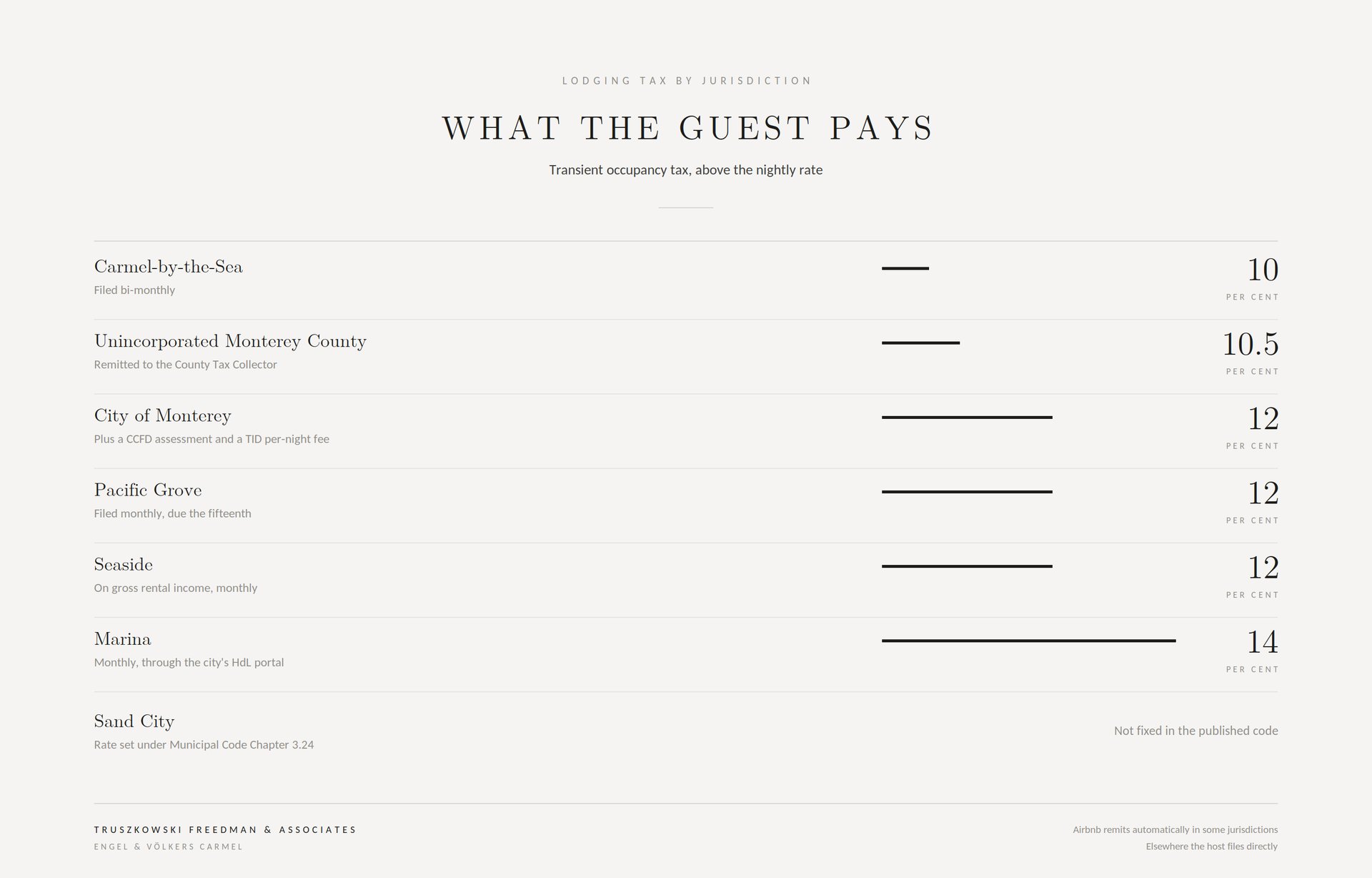
Every jurisdiction on this list collects transient occupancy tax on short-term rental income. The host collects it from the guest and remits it to the jurisdiction. Rates vary by four percentage points across the Peninsula, which matters more than it sounds when you are modeling nightly rates against comparable properties in a neighboring city.
| Jurisdiction | Rate | Filing |
| Carmel-by-the-Sea | 10% | Bi-monthly, plus business license and TOR certificate |
| Unincorporated Monterey County | 10.5% | Remitted to the County Tax Collector |
| City of Monterey | 12% | Plus CCFD assessment of 0.8% to 4.15% and a TID per-night fee |
| Pacific Grove | 12% | Monthly, due the 15th of the following month |
| Seaside | 12% | On gross rental income, monthly |
| Marina | 14% | Monthly, through the city's HdL portal |
| Sand City | Set under Municipal Code Ch. 3.24 | Not fixed in the published code |
Airbnb remits automatically in some jurisdictions. On other platforms, the host files directly. Confirm which applies to you before your first filing deadline rather than after.
Long-Term Rentals: The Statewide Rules that Apply Everywhere Here
Unlike short-term rentals, none of the 11 jurisdictions covered in this post currently have their own local rent control ordinance. Long-term leases of 30 days or more are governed primarily by California state law, uniformly, regardless of which community the property sits in.
Statewide rent cap, the Tenant Protection Act (AB 1482). Applies to most rentals that are not single-family homes or condominiums owned by an individual. LLC and corporate-owned single-family homes generally do not qualify for the exemption, and even qualifying owners must provide a specific statutory exemption notice to tenants. For the cycle running August 1, 2026 through July 31, 2027, Monterey County falls under the standard statewide cap of 8.6%, applied to the lowest rent charged in the prior 12 months. That is well below the higher caps set for Bay Area and Southern California metro counties.
Just-cause eviction (Civil Code §1946.2). Once a tenancy passes 12 months, landlords generally need a legally defined just cause to terminate. That means either a fault-based reason such as nonpayment or lease violation, or a no-fault reason such as owner move-in or intent to sell. No-fault terminations typically require relocation assistance to the tenant.
Security deposits (AB 12). As of July 1, 2024, most landlords are capped at one month's rent for a security deposit. There is no separate furnished-unit exception, and pet and cleaning fees now count toward that single cap. Small landlords, defined as a natural person or family trust owning no more than two rental properties totaling four or fewer units, may still charge up to two months' rent, except when renting to active-duty service members, who remain capped at one month regardless. As of July 1, 2025 under AB 2801, landlords must also photo or video document unit condition and provide an itemized deduction statement within 21 days of move-out.
Local business license. Several of these jurisdictions, including Carmel-by-the-Sea, the City of Monterey and unincorporated Monterey County, require a business license to operate any rental property for income, short-term or long-term. Check with the relevant city clerk or the county Treasurer-Tax Collector's office.
Habitability (Civil Code §1941.1). California requires landlords to provide a functioning, permanently installed heating system, among other basic habitability standards, regardless of city. This is not specific to any one Peninsula community, though it is frequently misunderstood as such.
Positive rent reporting (AB 2747, codified at Civil Code §1954.07). As of April 1, 2025, landlords must offer tenants the option to have on-time rent payments reported to at least one nationwide credit reporting agency. Tenants can decline, and can be charged the lesser of the actual cost or $10 per month. Landlords of a residential rental building with 15 or fewer units are exempt, which covers nearly every individual owner on this list. The exemption falls away only when both of two things are true at once: the landlord owns more than one residential rental building, and the landlord is a REIT, a corporation, or an LLC with at least one corporate member. Either condition on its own leaves the exemption intact. Owning several Peninsula rentals in your own name does not trigger the requirement, and neither does holding a single building through an LLC.
None of the 11 jurisdictions covered here currently layer additional local rent control or just-cause rules on top of the state baseline. That can change, and several California cities have adopted local ordinances in recent years, so it is worth a periodic re-check if you are managing a long-term rental portfolio on the Peninsula.
Frequently Asked Questions
Can you short-term rent a home in Carmel-by-the-Sea?
No, not in single-family R-1 zones. Carmel-by-the-Sea has prohibited rentals of under 30 consecutive days in residential zones on a long-standing basis, with multiple sources tracing the ban to 1989. The only legal transient rentals are in commercial and R-4 districts, and the city froze that category with Ordinance 2019-03 on December 3, 2019. Unless a property carries a Legal Nonconforming Permit or a Housing Incentive Permit, a home inside city limits cannot be legally rented for under 30 days.
Are short-term rentals legal in Pebble Beach and Del Monte Forest?
Legally permitted by the county, but often blocked in practice. Monterey County treats Del Monte Forest like any other coastal planning area and will issue Homestay, Limited Vacation Rental, and Commercial Vacation Rental permits up to the cap. However, the Pebble Beach Company takes the position that its private CC&Rs prohibit short-term use and controls access via the community's private roads, and it has been refusing the road-access consent it says those CC&Rs require. The county treats CC&R enforcement as a private civil matter, so a county permit does not resolve the conflict.
What are the three vacation rental license categories in unincorporated Monterey County?
Homestay, where the owner or resident manager is present during the stay, with no cap on licenses. Limited Vacation Rental, which is unhosted but capped at three rental contracts per calendar year, with no cap on the number of licenses. And Commercial Vacation Rental, which is unhosted with unlimited rental frequency, capped at roughly 4% of the housing stock in each planning area and banned outright in Big Sur, Carmel Highlands, and the Carmel Valley Master Plan residential districts.
How much does a Monterey County vacation rental license cost?
The base Vacation Rental Operation License is $965, roughly $1,152 with county processing fees, plus $301 if the property is on well or septic and a county business license at roughly $207 the first year. The figure most owners miss is the discretionary Coastal Development Permit required for Commercial Vacation Rentals in the coastal zone, which realistically runs $12,000 to $14,000. Inland commercial rentals may instead need a discretionary Use Permit historically quoted near $8,000.
Can I Airbnb a house in the City of Monterey?
No. The City of Monterey prohibits short-term residential rentals in all residential districts for any rental established after August 6, 1991. The city's position is that short-term rentals are banned everywhere except parcels specifically zoned Visitor Accommodation Facilities. A narrow pre-1991 grandfather clause required registration within 60 days and sunset within five years or on sale, so that window closed years ago. Advertising an illegal rental is a separate violation under section 22-19.5, charged per day.
What is the short-term rental cap in Pacific Grove?
Pacific Grove caps Short-Term Rental licenses at 250 citywide, with roughly 84 active as of our last check. Licenses are only allowed in Coastal and Commercial zones, not general residential zones, with one license per parcel and a 55-foot zone of exclusion from any other licensed STR parcel. A separate Home Sharing License for owner-present room rentals is allowed citywide with no cap and no zone restriction.
Are short-term rentals allowed in Big Sur?
Commercial Vacation Rentals are prohibited outright along the Big Sur coast, consistent with the Big Sur Coast Land Use Plan, which has never recognized short-term rentals as a principal residential use. Homestays and Limited Vacation Rentals of three or fewer contracts per year remain permitted. As of August 2026 this prohibition remains in effect despite the Monterey County Vacation Rental Alliance's lawsuit against the Coastal Commission's certification.
Can I short-term rent a property in Carmel Valley?
Partially. Commercial Vacation Rentals are banned within the Carmel Valley Master Plan's residential zoning districts, which are RDR, LDR, MDR, and HDR. Homestays and Limited Vacation Rentals capped at three rentals per year remain available where zoning otherwise allows. Carmel Valley sits in unincorporated Monterey County, so the county's Vacation Rental Ordinance governs rather than any city code.
Which Monterey Peninsula short-term rental caps are currently full?
Del Rey Oaks caps whole-home short-term rental licenses at 25 citywide and that cap is full, with new applicants placed on a waiting list. Seaside caps non-hosted rentals at 90 licenses and is not accepting new non-hosted applications, with a waitlist typically requiring a non-refundable deposit reported at $250. Paying an application fee anywhere a cap applies buys consideration, not a permit, and those fees are generally non-refundable.
Do ADUs, condos, or duplexes qualify for short-term rental permits in Monterey County?
No. In unincorporated Monterey County, only detached single-family homes qualify, including mobile and manufactured homes on permanent foundations. ADUs, JADUs, duplexes, and condominiums are not eligible for short-term rental use. Cities apply their own eligibility tests, and Marina allows single-family dwellings and duplexes but excludes condos, deed-restricted units, and properties with an ADU or JADU approved after January 1, 2020.
What is the transient occupancy tax rate on the Monterey Peninsula?
It varies by jurisdiction. Carmel-by-the-Sea is 10%, filed bi-monthly. Unincorporated Monterey County is 10.5%. Pacific Grove, Seaside, and the City of Monterey are each 12%. Marina is 14%. Lodging near the Monterey Conference Center may also owe a Conference Center Facilities District assessment of 0.8% to 4.15% plus a Tourism Improvement District per-night fee. Sand City's rate is set under Municipal Code Chapter 3.24.
Is there rent control on the Monterey Peninsula?
No local rent control ordinance currently applies in any of these cities or unincorporated areas. Long-term leases of 30 days or more are governed by California state law, principally the Tenant Protection Act. For the cycle running August 1, 2026 through July 31, 2027, Monterey County falls under the standard statewide cap of 8.6%, applied to the lowest rent charged in the prior 12 months. Just-cause eviction protections apply once a tenancy passes 12 months.
Why is a 30-day booking treated differently in Marina?
Marina draws its short-term rental line at 29 consecutive days or fewer, not the 30-day threshold used by Monterey County and every other city in this guide. A 30-day booking in Marina is already a long-term rental for code purposes. Marina also limits permitted properties to 180 short-term rental nights per calendar year, after which the home must revert to standard residential use for the rest of the year.
The Bottom Line
Short-term rental law on the Monterey Peninsula is a patchwork, and an actively moving one. Seven incorporated cities write their own rules. Four unincorporated communities run on a single county ordinance that has been rewritten twice and litigated continuously. A private covenant conflict sits on top of all of it in Pebble Beach. At least two lawsuits are working through the courts as of this writing.
Long-term rentals, by contrast, are comparatively simple. The same statewide rules apply everywhere on this list.
If you are buying with rental income in mind, short-term or long-term, the fees, caps and legal status above can and will keep shifting. Confirm current status directly with the relevant office before you rely on any number in this post, and loop in a local rental expert or real estate attorney for anything property-specific.
Water availability is the other constraint that governs what you can actually do with a Peninsula property, and it catches out-of-area buyers even more often than the rental rules do.
Questions about buying, selling, or renting on the Monterey Peninsula? Reach us at (831) 250-3560 (tel:8312503560) or [email protected] (mailto:[email protected]).
What Has Changed Since Our Last Update
Last verified September 14, 2026. We review this page quarterly.
- August 2026. The Monterey County Vacation Rental Alliance filed a further suit challenging the Coastal Commission's certification. No change to the operative rules.
- June 17, 2026. Marina re-allowed short-term rentals under tighter rules. Section rewritten.
- June 3, 2026. A tentative court ruling struck the county's corporate-ownership and out-of-state-owner restrictions. Caps, categories and the homestay presence requirement unchanged.
- January 6, 2026. The Board of Supervisors signaled support, 3 to 2, for a residential-zone STR ban in unincorporated county. Added to the litigation section. Not adopted.
Sources
Monterey County
- Monterey County Vacation Rental Ordinance overview
- Monterey County Vacation Rental Ordinances, Coastal and Inland, Current Planning
- Monterey County Short-Term Rentals, Permit Center
- Monterey County Transient Occupancy Tax information
- Monterey County Transient Occupancy Tax FAQ
Carmel-by-the-Sea
- Carmel-by-the-Sea Short-Term Rentals, City of Carmel
- Carmel-by-the-Sea Transient and Short-Term Rental Information, City of Carmel
City of Monterey
- Monterey City Code § 22-19.5, Advertisement of short-term rentals
- Monterey City Code § 38-26, Supplemental Regulations Applicable in R Districts
- Monterey City TOT, CCFD and TID FAQ
- City of Monterey Code Compliance
Pacific Grove, Marina, Del Rey Oaks, Seaside, Sand City
- Pacific Grove Short-Term Rental Program, City of Pacific Grove
- Marina Short-Term Rentals, City of Marina
- Del Rey Oaks Short-Term Rental License, City of Del Rey Oaks
- Del Rey Oaks Short-Term Rental Permit, City of Del Rey Oaks
- Ordinance 314, Del Rey Oaks Short-Term Rental Amendment
- Seaside Short-Term Rental Program, City of Seaside
- Sand City Standards, Procedures, and Fees for Short Term Rentals, municipal code
News and Reporting
- Coastal Commission certifies Monterey County's short-term rental ordinance, Monterey County NOW
- Coastal Commission approves Monterey County's vacation rental ordinance, Monterey County NOW
- County vacation rental ordinance stands, minus ownership restrictions, Monterey County NOW
- Supervisors back residential STR ban to thwart lawsuit, Monterey County NOW
- Pebble Beach Company and STR applicants head toward an impasse, Monterey County NOW
- Monterey's ordinance targets illegal short-term rentals, Monterey County NOW
- Marina again allows short-term rentals, but with new limits, Monterey Herald
Community and Industry
- Big Sur short-term rental information, Keep Big Sur Wild
- Del Monte Forest Property Owners FAQs
- Monterey County Vacation Rental Alliance, local city regulations summary
- Monterey County Vacation Rental Alliance, Monterey County regulations summary
California Statutes
- AB 1482, the Tenant Protection Act of 2019 — statewide rent cap and just-cause framework
- California Civil Code § 1946.2 — just cause for termination of tenancy
- California Civil Code § 1941.1 — habitability standards
- AB 12, tenancy: security deposits — one-month deposit cap, effective July 1, 2024
- AB 2801, tenancy: security deposits — move-out documentation, effective July 1, 2025
- AB 2747, tenancy: credit reporting — positive rent reporting, codified at [Civil Code § 1954.07