Fire Insurance and Zone 0: what California's new ember-resistant rules mean for Monterey Peninsula homes
Key takeaways
- Zone 0 is the five feet around a home. On August 19, 2026, California's Board of Forestry approved the nation's first statewide rules for it.
- It is not law yet. On September 8 the Board withdrew the package from state legal review to make technical edits. It plans to resubmit, and there is no effective date.
- It will reach much of the Peninsula: every structure in State Responsibility Areas (Big Sur, most of Carmel Valley) and Very High hazard parcels in cities and Pebble Beach.
- Insurers already credit this work. California's Safer from Wildfires rules require credit for a five-foot ember-resistant zone, though compliance does not guarantee a discount or coverage.
- For buyers and sellers, the first five feet are now part of every insurance quote, inspection and disclosure conversation.
If you own a home on the Monterey Peninsula, you have probably felt the insurance market tighten: higher renewals, non-renewal letters, and underwriters asking about your roof, your vents and your landscaping. California's new Zone 0 rules put a name, and soon a legal standard, on the part of the property those questions increasingly focus on: the first five feet around the house.
Research after recent wildfires shows most homes don't burn because a wall of flame reaches them. They burn because windblown embers land on something flammable right next to the house: a pile of mulch, a wood fence, dry leaves under a deck. That is why regulators and insurers are both focused on the same ground.
What is Zone 0?
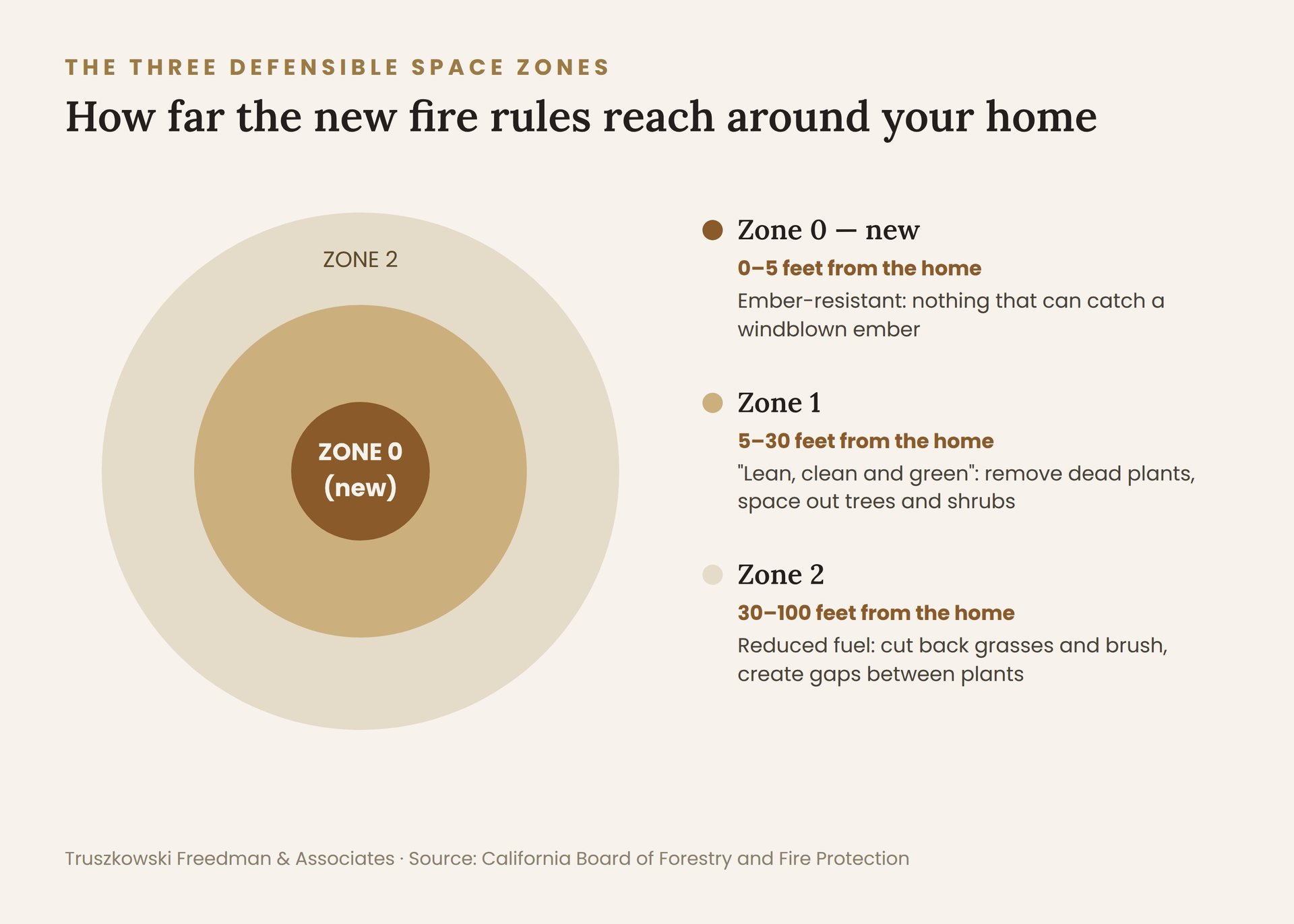
Zone 0 is the ember-resistant area within five feet of a home or other structure, measured from the exterior walls and attached decks. It is the newest of California's three defensible space zones. Zones 1 and 2 have been required for years; Zone 0 adds a stricter standard closest to the house.
Is Zone 0 law yet?
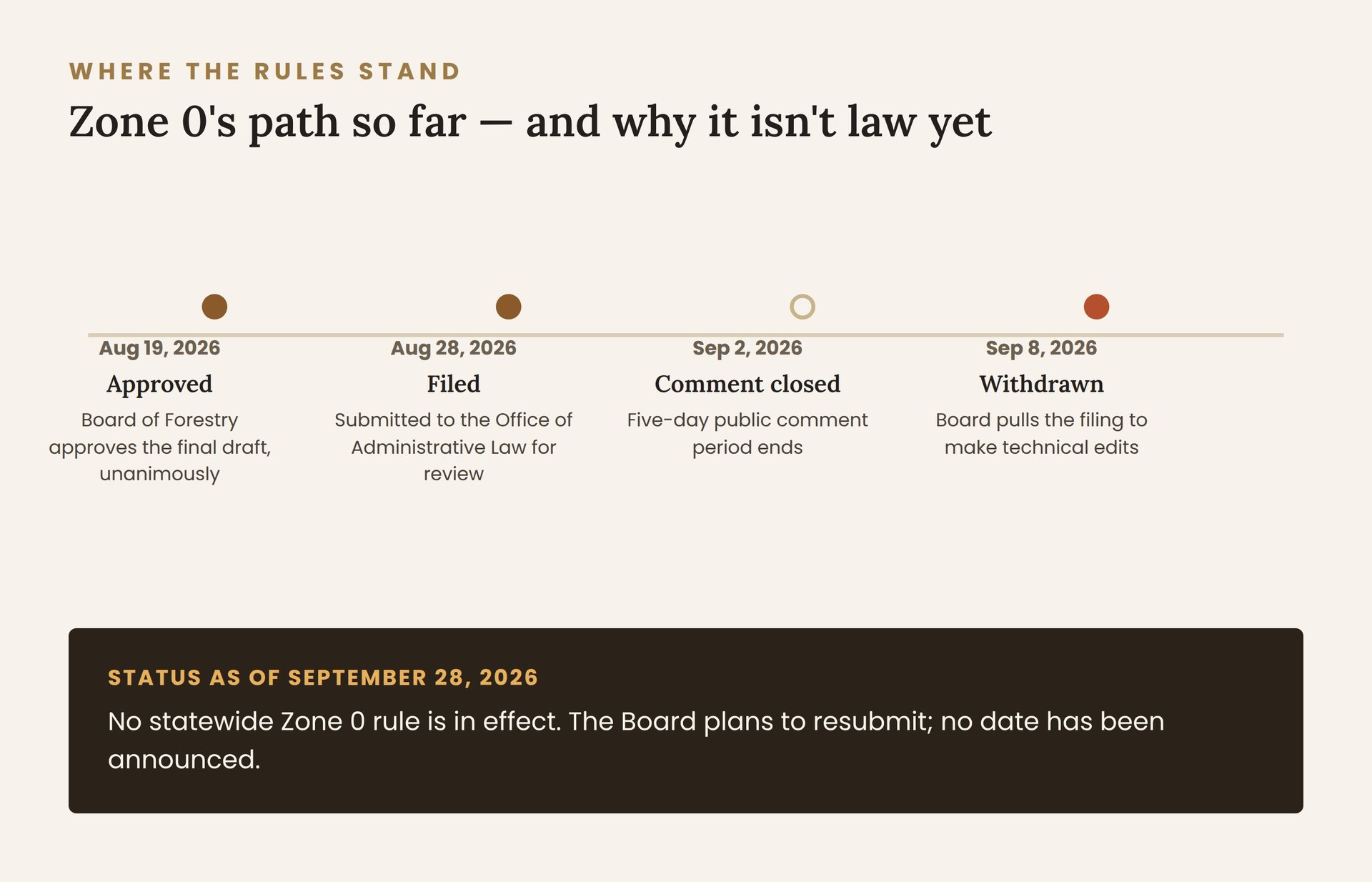
Not yet. As of September 28, 2026, no statewide Zone 0 rule is in effect, and there is no effective date. Here is where the process stands:
- August 19, 2026: The Board of Forestry and Fire Protection approved the final draft unanimously.
- August 28, 2026: The Board submitted it to the Office of Administrative Law (OAL) as an emergency regulation.
- September 8, 2026: The Board withdrew the package from OAL review. It has described the withdrawal as procedural, to work through technical edits and questions, and expects to resubmit. No timetable has been announced.
Because the package is being revised, details could change before it takes effect. As approved in August, the rollout would work like this once the rules are final: items already required under prior law (clearing roofs and gutters, no firewood in Zone 0, removing dead branches, chimney clearance) apply immediately; other combustible materials and vegetation for existing homes phase in over roughly three years; attached fence and gate sections, sheds and outbuildings phase in over three to five years depending on SRA/LRA status; and new construction complies once the Board updates its fuels-management guidance, which it has up to a year to do. The state has said it will prioritize education and outreach over penalties during the phase-in. We will update this post when the Board resubmits.
Does Zone 0 apply to my home?
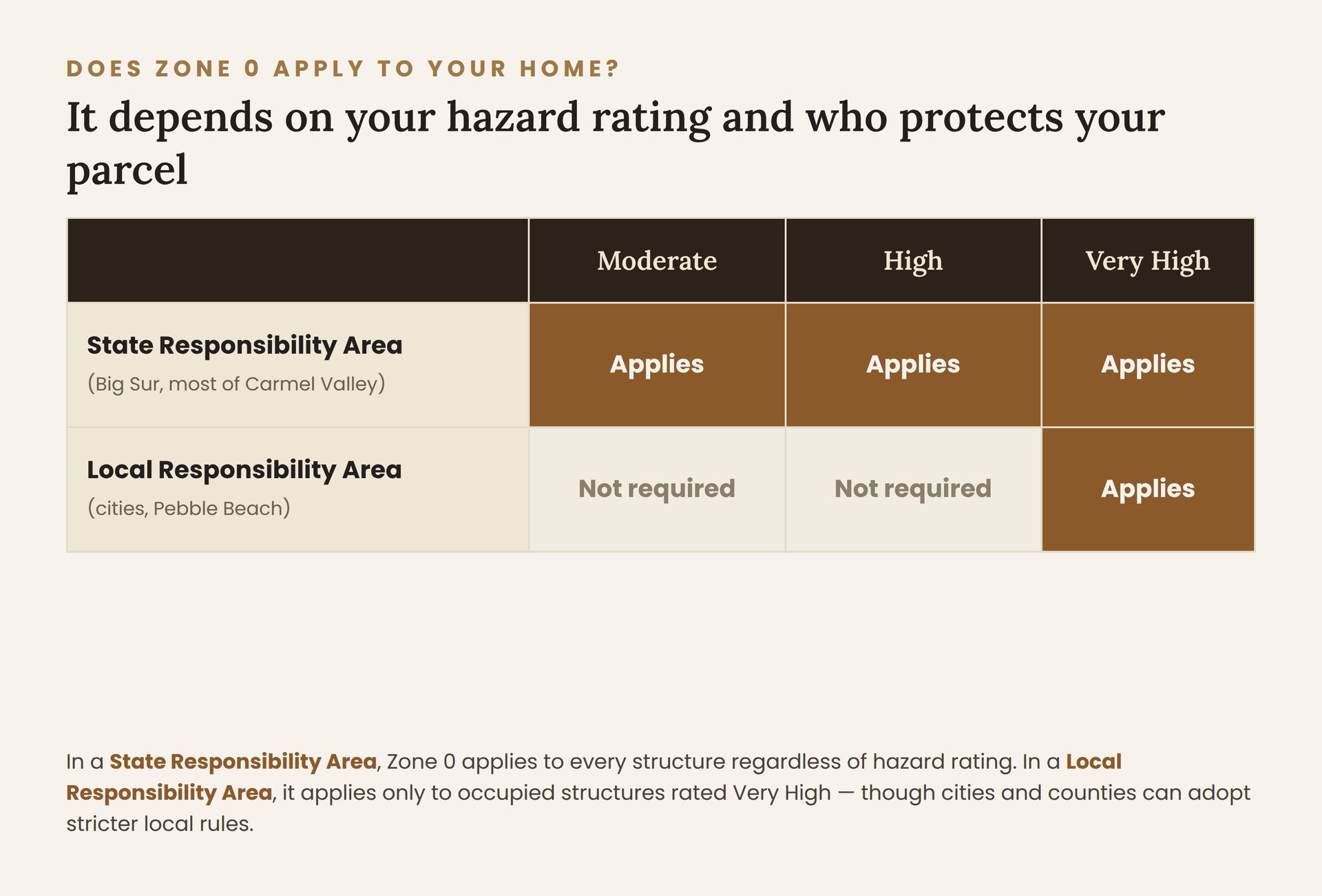
It depends on two things: who is responsible for fire protection where you live, and your fire hazard severity rating (Moderate, High or Very High).
- State Responsibility Area (SRA): mostly unincorporated, wildland-adjacent land where CAL FIRE is responsible. Zone 0 applies to all buildings and structures, at every hazard rating.
- Local Responsibility Area (LRA): cities and areas protected by local fire departments. Zone 0 applies only to occupied structures in a Very High Fire Hazard Severity Zone. Cities and counties can still adopt stricter local rules.
CAL FIRE issued updated local hazard maps on March 10, 2025, and many neighborhoods that were never mapped before are now rated. If you haven't checked your property since then, enter your address in the CAL FIRE Fire Hazard Severity Zone Viewer. It shows both your rating and whether you're in an SRA or LRA.
Zone 0 on the Monterey Peninsula, community by community
The key question in each community is whether a property sits in a State Responsibility Area, where the rules apply at every hazard level, or a Local Responsibility Area, where Zone 0 applies only in Very High zones.
Community | Responsibility area | Zone 0 applies to |
|---|---|---|
Big Sur | SRA | All structures, any rating |
Carmel Valley | Mostly SRA, some LRA | All structures in SRA; Very High only in LRA |
Pebble Beach | Mostly LRA | Very High parcels (many) |
Carmel-by-the-Sea | LRA | Very High parcels (much of the city) |
Pacific Grove | LRA | Very High parcels (mainly forested south and west edges) |
Monterey | LRA | Very High parcels |
Seaside | LRA | Very High parcels (mainly the eastern edge) |
Del Rey Oaks | LRA | Very High parcels (mainly the eastern edge) |
Marina | LRA | Very High parcels (likely few) |
Carmel-by-the-Sea (LRA). The updated map puts about 278 acres in the Very High zone, up from 221, plus 110 acres High and 100 acres Moderate. The City formally adopted the Very High map in its 2026 building and fire code update, which also lowered the threshold for required fire sprinklers.
Pebble Beach / Del Monte Forest (mostly LRA). Much of Pebble Beach is included in the 2025 local maps, and with its forest cover many parcels rate High or Very High. CAL FIRE provides fire service under contract with the Pebble Beach Community Services District, which already runs defensible space and home-hardening programs.
Carmel Valley (a mix of SRA and LRA). Most of the hillside and upper valley is state responsibility land, where Zone 0 applies to every structure along with the existing 100-foot defensible space requirement. Parts of the valley floor may be local responsibility instead, so checking your parcel's status comes first.
Big Sur (overwhelmingly SRA or federal land). Nearly all private property is state responsibility land, much of it surrounded by Los Padres National Forest. Zone 0 will apply to essentially every home and outbuilding, regardless of rating.
Pacific Grove (LRA). Very High acreage roughly doubled, from 82 to 167 acres, with another 64 acres High and 141 acres Moderate. The new Very High areas are concentrated in forested neighborhoods near the Del Monte Forest and George Washington Park; the waterfront and downtown generally rate lower.
Monterey (LRA). The City has 1,220 acres rated Very High (up from 1,106), 1,020 acres High and 511 acres Moderate. Wooded neighborhoods near the forest edge and open space are most likely to be Very High. Monterey Fire also serves Pacific Grove, Carmel-by-the-Sea and Sand City.
Seaside (LRA). Seaside's map includes Moderate, High and Very High areas. The highest risk sits along the upper General Jim Moore Boulevard corridor, next to former Fort Ord open space.
Del Rey Oaks (LRA). This small city borders the oak woodland and open space of the former Fort Ord. Properties on its eastern edge are the most likely to rate High or Very High.
Marina (LRA). Coastal dune and scrub vegetation generally rates lower than the wooded Peninsula communities. Homes nearest the Fort Ord lands should still check their parcel.
Ratings can change from one side of a street to the other, so always confirm the specific address rather than relying on the community.
What does Zone 0 require?
In short: nothing that can catch an ember within five feet of the house, with the strictest standard right against the walls. These are the requirements as approved in August; the final text may be adjusted on resubmission.
Right next to the home. Keep the area directly against the house free of vegetation, firewood, bark mulch, wood chips and dead leaves. This noncombustible strip is at least one foot wide, or to the edge of the eaves.
Across the full five feet:
- No stacked firewood and no wood-chip or bark mulch. Gravel, pavers and concrete work well.
- Low-growing, well-maintained, irrigated non-woody plants or lawn are allowed in the outer part of the zone.
- Existing trees can stay if they are properly trimmed, cleared of dead branches and ladder fuels, and kept clear of the roof, eaves, walls and chimney.
- Keep roofs and gutters clear, and remove plants and stored items from beneath decks, balconies, pergolas and stairs.
Fences, gates and sheds:
- Where a fence or gate attaches to the home, the first five feet must be noncombustible, such as metal or masonry.
- New combustible fences and gates are banned within Zone 0.
- Sheds and outbuildings within Zone 0 must be built of noncombustible materials.
How does Zone 0 affect fire insurance?
Zone 0 is a fire-safety rule, not an insurance rule, but the two now overlap. California already requires insurers that price by wildfire risk to give credit for a five-foot ember-resistant zone, so doing the work can matter at your next renewal, whether or not the state rule has taken effect.
Insurers must credit mitigation under Safer from Wildfires
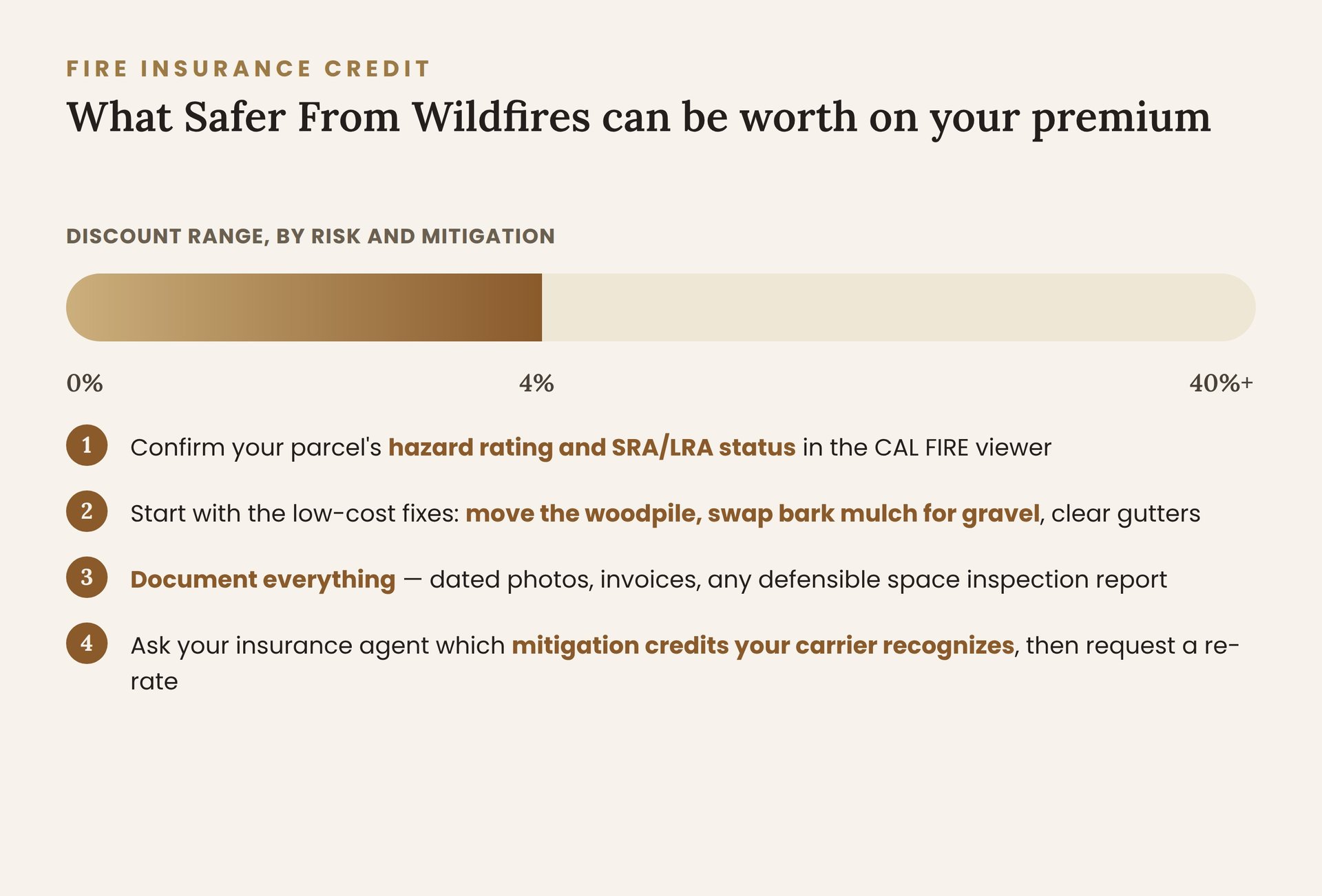
California's Safer from Wildfires regulation, adopted by the Department of Insurance in 2022, requires insurers that vary price by wildfire risk to give credits or discounts for specific mitigation. The list includes a five-foot ember-resistant zone, a Class A fire-rated roof, ember- and fire-resistant vents, cleared defensible space, and community designations such as Firewise USA. Insurance Commissioner Ricardo Lara has said available discounts range from about 4% to more than 40% of total premium, depending on wildfire risk, the property, and the combination of measures.
Compliance is not a guaranteed discount
Zone 0 and Safer from Wildfires are separate standards. Each insurer uses its own filed rating plan and its own verification process, so meeting Zone 0 does not automatically produce a specific discount or an offer of coverage. What it does is put the property on the right side of the questions underwriters are asking.
Mitigation now shapes who gets offered coverage
Under the state's Sustainable Insurance Strategy, insurers can now use reviewed, forward-looking wildfire catastrophe models in ratemaking, in exchange for commitments to write more policies in higher-risk areas. Those models are designed to account for mitigation at the property and community level rather than relying only on past losses. In practice, a hardened home with a clean first five feet is increasingly a better candidate for the admitted market, not just a cheaper one.
Help paying for the work
The California Safe Homes Act (AB 888), in effect since January 1, 2026, establishes a Department of Insurance grant program to help eligible homeowners pay for hardening, including fire-safe roofs and Zone 0 mitigation. Check with the Department of Insurance for current eligibility and funding.
What to do before your next renewal
- Confirm your parcel's status in the CAL FIRE viewer: hazard rating and SRA or LRA.
- Start with the low-cost items: move the woodpile, replace bark mulch with gravel or pavers, clear gutters and the space under decks.
- Document everything: dated before-and-after photos, invoices, and any defensible space inspection report from your fire agency.
- Ask your insurance agent or broker which mitigation credits your carrier's filing recognizes and what proof it needs, then request a re-rate.
- If you're on the FAIR Plan, ask whether your mitigation documentation opens options with an admitted carrier.
What does Zone 0 mean if you're buying or selling?
- Sellers: In High and Very High hazard zones, California already requires certain fire-related disclosures at sale, including a home-hardening disclosure for many older homes and proof of defensible space compliance where a local inspection program exists. Zone 0 work is usually modest, such as swapping mulch for gravel or moving the woodpile. Done and documented before listing, it removes a question buyers, inspectors and insurers increasingly ask, and it lets fire readiness appear in your marketing as a strength.
- Buyers: Get homeowners insurance quotes in the first days of your contingency period, not the last. Your lender will need proof of coverage to fund the loan, and the property's roof, vents and first five feet will shape what you're offered. Walk the perimeter the way an ember would, and budget for replacing attached wood fencing or bringing a shed into compliance.
- Everyone: Insurability has become part of a home's value on the Peninsula. A home that is easy to insure is easier to sell.
How is Zone 0 different from Firewise USA?
The two are related but separate. Zone 0 will be a legal requirement for individual properties. Firewise USA is a voluntary recognition program from the National Fire Protection Association that neighborhoods earn by forming a local committee, completing a wildfire risk assessment and investing in yearly risk-reduction work. Zone 0 compliance across a neighborhood makes Firewise recognition easier to achieve, and Firewise recognition is one of the community-level credits insurers consider under Safer from Wildfires.
Frequently asked questions
What is Zone 0 in California?
Zone 0 is the ember-resistant area within five feet of a home or other structure. California's Board of Forestry approved the first statewide rules for it on August 19, 2026. They limit anything in that space that can catch an ember, including bark mulch, firewood, dead vegetation and combustible fencing attached to the house.
Is California's Zone 0 rule in effect yet?
No. As of September 28, 2026, no statewide Zone 0 rule is in effect. The Board of Forestry approved the rules on August 19, 2026, submitted them for state legal review on August 28, and withdrew them on September 8 to make technical edits. The Board expects to resubmit but has not announced a date.
Does Zone 0 apply to homes in Carmel, Pebble Beach and Carmel Valley?
It depends on the parcel. Zone 0 will apply to every structure in a State Responsibility Area, which covers Big Sur and most of Carmel Valley, and to Very High hazard parcels in Local Responsibility Areas, which include much of Carmel-by-the-Sea and many Pebble Beach parcels. Check your address in CAL FIRE's Fire Hazard Severity Zone Viewer.
How do I find my property's fire hazard severity zone?
Enter your address in CAL FIRE's Fire Hazard Severity Zone Viewer. It shows your hazard rating (Moderate, High or Very High) and whether you are in a State or Local Responsibility Area. CAL FIRE updated local maps on March 10, 2025, so check again even if you looked before then.
Will Zone 0 lower my homeowners insurance premium?
It can, but it isn't automatic. California's Safer from Wildfires regulation requires insurers that price by wildfire risk to give credit for mitigation, including a five-foot ember-resistant zone. The Insurance Commissioner has said available discounts range from about 4% to more than 40% of premium. Each insurer applies its own filed rates and verification rules.
What should I show my insurer after doing Zone 0 work?
Keep dated before-and-after photos, contractor invoices and any defensible space inspection report from your local fire agency. Ask your insurance agent or broker which mitigation credits your carrier recognizes and what proof it requires, then ask for your policy to be re-rated.
Do I have to replace my wood fence under Zone 0?
Not the whole fence. As approved, the rules require the first five feet of a fence or gate attached to the home to be noncombustible, such as metal or masonry, and ban new combustible fencing within Zone 0. For existing homes this is a later-phase requirement, with years to comply once the rules take effect.
How does Zone 0 affect selling a home on the Monterey Peninsula?
Buyers now check insurability early, and fire readiness is part of that. In High and Very High hazard zones, sellers already owe certain fire-related disclosures. Zone 0 work done before listing is usually modest in cost and removes a question that buyers, inspectors and insurers increasingly ask.
What is the difference between Zone 0 and Firewise USA?
Zone 0 will be a legal requirement for individual properties. Firewise USA is a voluntary recognition program from the National Fire Protection Association that neighborhoods earn through a local committee, a wildfire risk assessment and yearly risk-reduction work. Firewise recognition is one of the community-level credits insurers consider under Safer from Wildfires.
The bottom line
Zone 0 is about the small things closest to the house, and so, increasingly, is your insurance. For most homeowners, compliance means moving the firewood, replacing bark with stone and rethinking where the fence meets the wall. The state rule has been delayed, but the insurance market isn't waiting for it. Starting now is better than waiting for a deadline, a renewal notice or a buyer's inspection.
Protect the home, the policy and the sale
On the Monterey Peninsula, insurability is now part of what a home is worth. We help owners get ahead of it, whether you plan to stay for decades or list next spring.
For homeowners: a complimentary Zone 0 and insurance-readiness walk-through. We'll confirm your parcel's hazard rating and SRA or LRA status, walk the first five feet with you, and leave you with a prioritized checklist plus the documentation insurers ask for.
For sellers: a pre-listing fire-readiness review. Before you list, we'll identify which fire disclosures apply to your property, flag what buyers, inspectors and insurers will ask about, and prioritize the low-cost fixes that remove objections.
Our walk-throughs are an informal real estate review. They are not a CAL FIRE inspection, insurance advice, or a guarantee of any coverage or discount.
Sources
- California Wildfire & Forest Resilience Task Force: Board approves Zone 0 regulations
- BB&K Law: Board of Forestry adopts emergency Zone 0 regulations under AB 3074
- Wildfire Los Angeles: Zone 0 regulations withdrawn from OAL review
- Board of Forestry: Defensible Space Zones 0, 1 and 2
- Insurance Business: Zone 0 compliance does not guarantee a discount
- California Wildfire & Forest Resilience Task Force: New laws on home hardening and insurance access (AB 888)
- Monterey County Weekly: Updated fire hazard map shows growth in Very High acres
- City of Carmel-by-the-Sea Ordinance 2026-001
- City of Monterey: Fire Hazard Severity Zones
- KION: Seaside's new fire hazard maps
- CAL FIRE Fire Hazard Severity Zone Viewer
Nicole Truszkowski | CA DRE# 01240204 Zak Freedman | CA DRE# 01956633