For twenty-eight years, the shorthand for this stretch of Carmel has been the Barnyard: seven rustic barns, brick courtyards, a Tuesday market, dinner at SUR. That version of the corridor is intact. It is also no longer the most consequential thing happening at the intersection of Highway 1 and Carmel Valley Road.
The consequential thing is on the other side of the road, where a former golf course is being turned back into a river. Read together with a year of Barnyard turnover, the two stories describe a single shift in what daily life looks like from a Carmel Rancho address in July 2026.
The Barnyard's Roster, Reshuffled
The most talked-about arrival is Hatch Southwest Kitchen, which opened February 9, 2025 in Suite D11. Hatch is the second concept from Stephen Wilson and Kristen Ridout, who already run Toro Japanese Cuisine in the village, with Stephen's brother Jamie. The menu leans on green chile chutney, a hundred-percent-brisket smash burger, and a brioche bun sourced next door from Lafayette French Bakery. The Wilsons lived in Rio Rancho outside Albuquerque for six formative years, and the sopapillas are meant as an authenticity check for anyone who did the same.
Around Hatch, the courtyard has quietly filled in. Carmel Groomers is open. So is Modfruit. Pieces of Heaven Fine Chocolates is under new ownership. Aabha Indian Cuisine has a remodeled outdoor patio and buffet. The village directory still lists SUR at The Barnyard, From Scratch, Lugano Swiss Bistro, O'Callaghan's Irish Pub, Allegro Pizzeria, LadySomm, and Hidden Hills Brewing & Blending. SUR was named Carmel's Small Restaurant of the Year.
Post No Bills opened in the former Erik's Deli space at 3740 The Barnyard, Suite H11 on August 3, 2023 after a two-and-a-half-year buildout. Owner Kye Ricks announced this March that both the Barnyard location and the original Sand City taproom would close, citing pandemic-era EIDL and SBA debt, rising operating costs, and a rotted-out kitchen floor that appeared during construction. The Carmel location closed at the end of March 2026.
One departure against a half-dozen arrivals is not a slump. It is a village re-tenanting itself faster than it used to.
Tuesday, 9 to 1
The farmers market at the Barnyard is in its twenty-first year. Hosted by Monterey Bay Certified Farmers Markets in partnership with the shopping village, it runs every Tuesday from 9 a.m. to 1 p.m., May through September, rain or shine, adjacent to Patrick James and Allegro Pizzeria. More than twenty-five farmers and specialty food vendors show up. Per California Health and Safety Code, animals other than service animals are prohibited on the market footprint, which is worth knowing if you are used to bringing a leashed dog into the Barnyard's other pet-friendly patios.
The market is the one weekly event that reliably brings the corridor's residential population into the courtyards during daylight hours. It is also the reason the Barnyard's late-morning parking is tighter on Tuesdays than on any other weekday.
What the Anniversary Is Actually Celebrating
The Barnyard is marking its twenty-eighth anniversary this year with a wine reception and Ferrari exhibition curated by the Big Sur Food & Wine Festival. The framing matters. The village opened as a shopping center. It now positions itself as a small events venue with a shopping center attached, and the anniversary bill is the clearest statement of that shift. The other public events on the 2026 calendar include a holiday-themed pet parade that begins in front of Carmel Groomers and finishes at Hatch, which reads as an unusually deliberate handoff between the newest tenant on each end of the courtyard.
Across Carmel Valley Road, a Golf Course Is Becoming a River
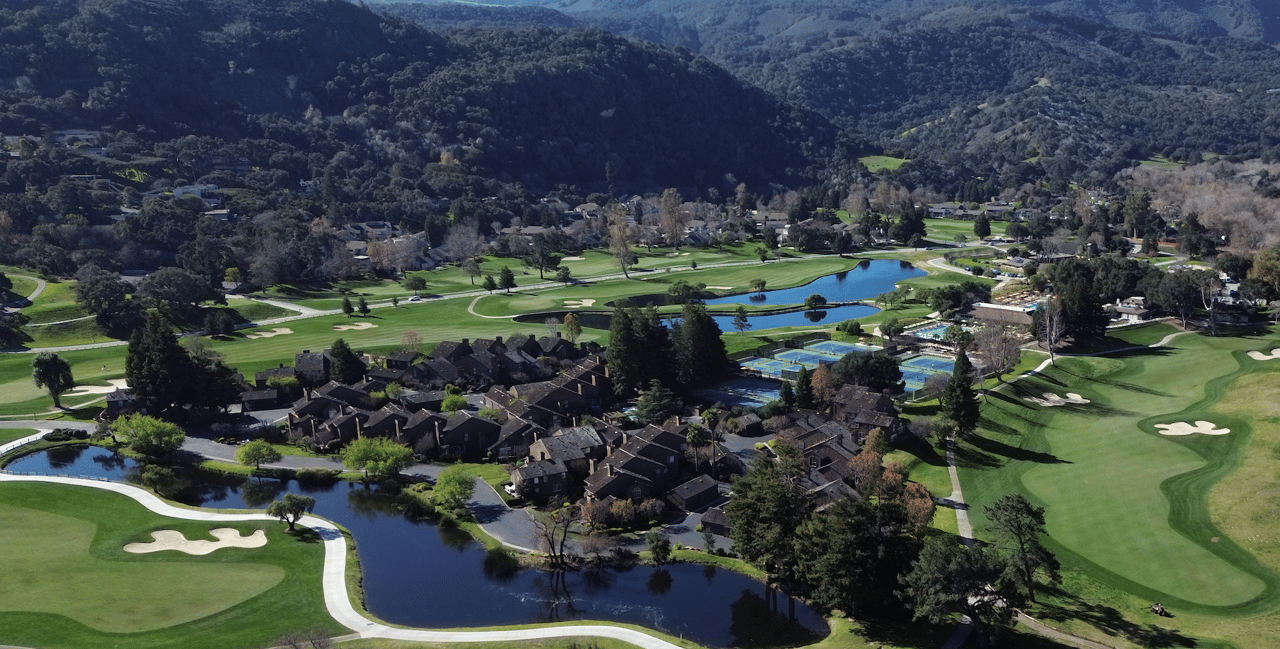
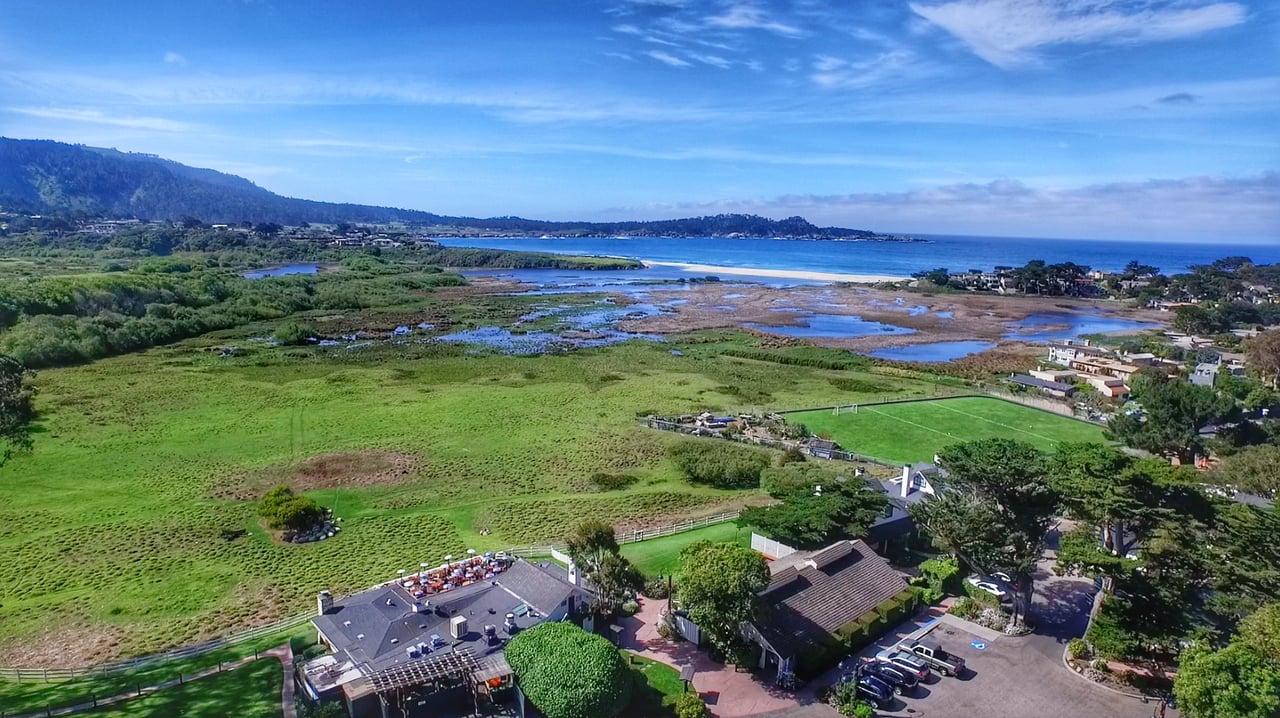
Now the larger story. In 2018 a consortium including the Trust for Public Land, the Santa Lucia Conservancy, the California State Coastal Conservancy, and Trout Unlimited acquired 190 acres of the former Rancho Cañada Golf Course and added it to Palo Corona Regional Park as the Rancho Cañada unit. The former clubhouse now serves as the Monterey Peninsula Regional Park District headquarters, a Discovery Center, and a public trailhead. Palo Corona overall runs to roughly 4,350 acres, holds more than five hundred plant species, and supports federally protected wildlife including the California red-legged frog and Smith's blue butterfly.
The active piece of that story is the Rancho Cañada Floodplain Restoration Project, a partnership among the Monterey Peninsula Regional Park District, the California State Coastal Conservancy, the U.S. Fish and Wildlife Service, NOAA Fisheries, the California Department of Fish and Wildlife, the Regional Water Quality Control Board, CSUMB, the Trust for Public Land, the Monterey Peninsula Water Management District, Trout Unlimited, and the Carmel River Task Force. During its operating life, the golf course was the second-highest water user on the Carmel River. The project is unwinding that, one mile of river at a time.
The specific interventions matter, because most of them are visible from the trail:
- Three existing bridges built for golf carts will be removed. They were a safety hazard and a constraint on the river's ability to migrate.
- One new pedestrian bridge is being built, rated for emergency vehicle access, sited to minimize constraint on the channel.
- Roughly forty acres of connected floodplain will be created and revegetated with native plants, with irrigation drawn from the replaced driving-range well.
- Existing large mature trees are being left in place where possible. Vegetation that has to come out is being reused as rootwad logs and large wood habitat features in the new floodplain.
- Riprap that is not protecting critical infrastructure is being removed. Backwater alcoves are being cut into the channel.
The park remains open during construction. The public can access the Rancho Cañada unit outside the phase exclusion fencing for each stage of work.
The Rancho Cañada Entrance, in Practical Terms
The reason this matters to a Carmel Rancho resident is access. From Highway 1, take Carmel Valley Road to Village Park Road, next to the Community Church of the Monterey Peninsula. Turn left and the entrance is on your left. No permit is required from this entrance. Parking is ample. Leashed dogs are welcome on the Rancho Cañada unit, which is the exception rather than the rule in the Palo Corona system; the west gate off Highway 1 and the east gate off Rancho San Carlos Road both require access permits arranged through the district in advance.
The walk itself is unusually forgiving for a Peninsula trail. The old cart paths give you a flat option along the Carmel River suitable for a stroller or a slow pace, with the climb to Inspiration Point and Gregg's Hill available if you want it, and Animas Pond, home to the federally threatened red-legged frog and, in spring, a surface bloom of red Azolla, sitting quietly at the top of the ridge.
The immediate neighbors named in project documents are Carmel Middle School, the Hacienda Carmel retirement community, the Santa Lucia Conservancy, and a horse farm. Immediately downstream sits the 60-acre Rancho Cañada Village site, a proposed residential development still working its way through review. None of these are new. What is new is that a resident walking from the Barnyard side of Carmel Valley Road now crosses into an active restoration site rather than a quiet former fairway.
The Corridor, in Late July
Read the two sides of Carmel Valley Road together and the picture clarifies. The Barnyard did a year of small, cumulative changes: a New Mexican kitchen from a familiar Carmel operator, three or four new specialty tenants, one high-profile closure, a market entering its third decade, and an anniversary program that treats the village as a venue. Across the road, the corridor gained a permit-free trailhead, a Discovery Center, and an active river restoration that will reshape how the Carmel River runs past the corridor for the next generation.
For a resident, the effect is subtle and immediate at once. The Tuesday errand still ends at the Barnyard. The Saturday walk now starts at Village Park Road. The corridor has widened without a single new address being built.
If you own a home in the Carmel Rancho corridor and want a considered read on how the changes on either side of Carmel Valley Road are being priced into the market, the team at Truszkowski Freedman & Associates is available for a private conversation. Work With Us.