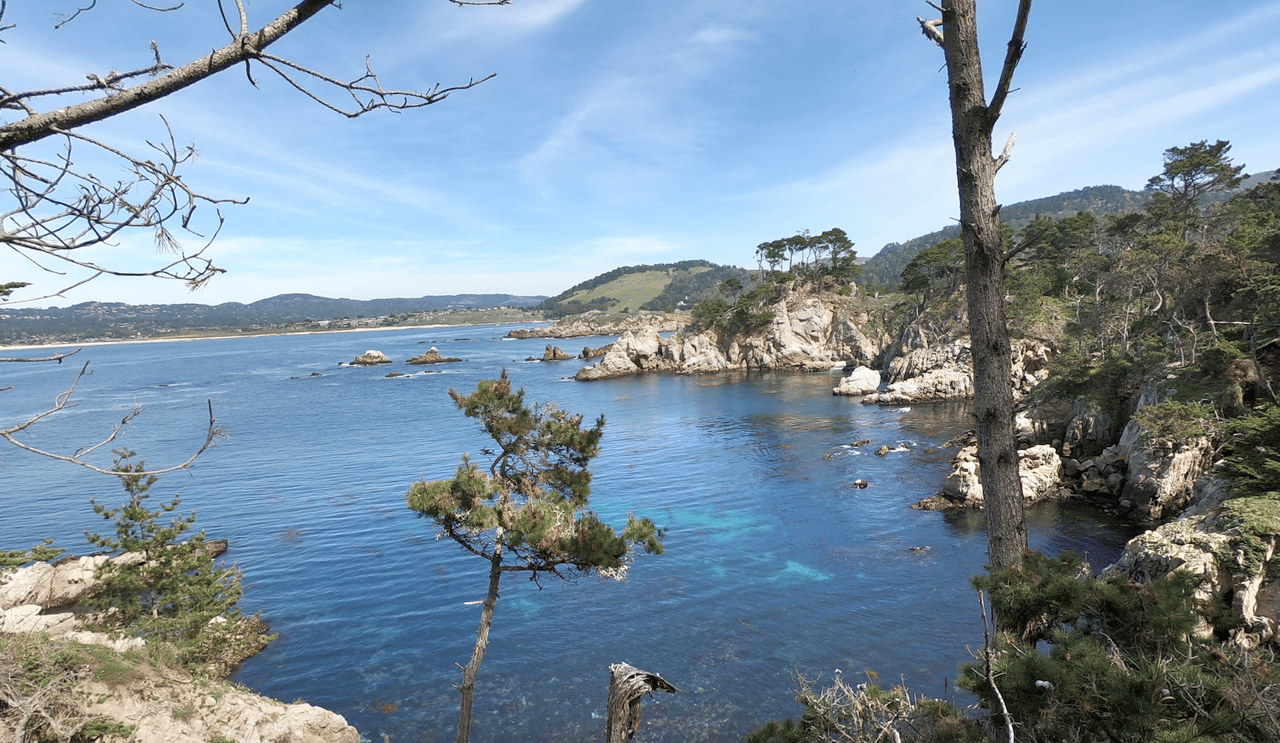
For anyone who bought in Otter Cove or along Yankee Point, the pitch was partly about the fence line. Three miles of the most photographed coast in California, and the gate is a short walk from your front door. Docents on the trail knew you by name. If the fog burned off at ten, you could be inside by ten fifteen.
That version of Point Lobos is ending. The ParkIT! program, developed since 2018 by California State Parks with the Point Lobos Foundation, Monterey Peninsula Regional Park District, Big Sur Land Trust, and Big Sur International Marathon Foundation, is moving the reserve onto a reservation and shuttle system. The core mechanic is straightforward and, for a resident, worth understanding in detail before the first morning it applies to you.
What Actually Changes at the Kiosk
The reserve has been running on a first-come rule against a hard ceiling of 150 parking spaces and roughly 600,000 visitors a year, with peak summer weekends pushing 6,000 people in a single day. The relief valve was Highway 1: cars stacked along the west shoulder for up to a mile, pedestrians walking the fog line back to the entrance kiosk. The county banned east-side shoulder parking in 2018 after enough near-misses to make it unavoidable.
Under ParkIT!, that relief valve closes. According to the program's own materials, "for the majority of days, those attempting to park on the highway and walk in will be turned away at the kiosk." A reservation, either for a spot inside the reserve or for the Marathon Flats lot at Rio Road and Highway 1 with a shuttle seat, becomes the entry ticket. Pedestrians and cyclists still pay nothing, but they still need a reservation under the new system.
For a resident who has been treating the reserve as a walk-in backyard, that is the sentence to reread.
The Categories That Preserve Spontaneity
The program was designed with local use cases in mind, and the FAQ on parkitforparks.com spells out several paths that avoid the reservation queue entirely or work around it:
- The morning-release block. Each morning, a set of reservations is released for same-day spontaneous visitation. Both Reserve and shuttle parking will be options within that block.
- Docent shifts. If you volunteer with the Point Lobos Foundation, your shift acts as your reservation, and parking inside the reserve is included. This is the cleanest path to routine, no-friction access for anyone with the time and interest.
- Diver permits. Certified divers with confirmed permits at Whalers or Bluefish Coves receive a reservation and on-reserve parking.
- Bike arrivals. Cyclists can either book in the initial release months ahead or take a same-day slot.
The program director Steffanie Gamecho, who also runs the Point Lobos Foundation, has framed the initial capacity as intentionally conservative: 900 reservations per day inside the reserve and 567 at Marathon Flats, with the option to expand once operations settle. The docent path is the one worth flagging for Highlands residents specifically, because it converts a habit into a role and preserves the "I'll go now" impulse that made the neighborhood feel the way it does.
Reservation blocks will be released each morning for spontaneous visitation to the Reserve across the day.
That sentence, quoted from the ParkIT! FAQ, is the closest the program comes to a promise for locals. Treat it as a soft window, not a guarantee.
The Numbers, Against the Baseline
Read next to the current operation, the ParkIT! capacity looks less like a restriction than a reallocation:
Metric | Current | Under ParkIT! Phase 1 |
|---|---|---|
Parking spaces inside reserve | 150 | 150 (booked) |
Peak weekend visitors | ~6,000 | ~2,900 across Reserve + Marathon Flats bookings, assuming 3 per car, two turns |
Highway 1 shoulder walk-ins | ~250 spots turning twice daily | Restricted, subject to kiosk turnaway |
Same-day access for locals | First-come only | Morning-release block plus docent shifts |
Reservation window | None | Released a set interval ahead, exact horizon TBD |
The number worth staring at is the peak weekend one. If the estimates hold, an August Saturday inside the reserve will have roughly half the foot traffic of the recent baseline. For anyone whose complaint about Point Lobos in July has been that it stopped feeling like Point Lobos, that is the trade the program is asking residents to make: a booking friction in exchange for a quieter reserve on the days you actually want it quiet.
What Moves to the Evening Half of the Day
If the morning becomes booked, the flexible half of a Highlands day shifts to the afternoon and evening, and the neighborhood is unusually well set up for it inside a walkable half mile.
Sunset Lounge at Hyatt Carmel Highlands has been operating in some form since the property opened in 1917. It is a glass-enclosed room with small plates, seafood, and a wine list oriented toward the local coast, and it takes reservations without the seasonal squeeze of the town restaurants down the hill. On select nights there is live music. For a resident who used to walk the reserve at nine and eat lunch at home, moving that same social hour to five and taking a table with a west-facing view is a lateral trade, not a downgrade.
Pacific's Edge, the hotel's other room, is the dinner version of that argument. The kitchen runs seasonal menus and a longer wine list, and the room sits on the same bluff. Neither restaurant is a discovery for anyone who lives here. The point is that they are close enough to walk to and open on a schedule that no longer competes with a morning trail decision.
Tickle Pink Inn, four doors down at 155 Highland Drive, holds a nightly wine-and-cheese reception on its ocean-view deck for guests. Residents are not guests, but the deck itself is a reminder that the neighborhood's operating hours were always tilted toward evening. The building has been running since 1953 under the same family, and Krysty P still signs the general manager responses on Tripadvisor in 2026. That kind of continuity is the reason the block feels the way it does after five.
Soberanes as the Unreserved Alternative
For the morning walk itself, the closest substitute is Garrapata State Park, five to seven minutes south on Highway 1. Garrapata has no entrance fee, no kiosk, no reservation, and no visitor booth. Gates 7 and 8 open onto the Soberanes Point bluff loop and, for anyone with the legs for it, the Soberanes Canyon to Rocky Ridge loop behind it. Gates 18 and 19 drop into Garrapata Beach at the south end of the park's four-mile shoreline.
There are trade-offs. Garrapata has ticks. The name is Spanish for the animal, and the interior canyons hold them at any warm-weather elevation. Parking is on the highway shoulder, which is the same failure mode that pushed Point Lobos onto ParkIT! in the first place, and the county is watching. Bluff traffic on Soberanes has been rising steadily as Point Lobos overflow shifts south, and it is reasonable to expect that a version of the same conversation will reach Garrapata within a few years.
For now, Soberanes is the unreserved backyard trail. If Point Lobos is a booked room, Garrapata is the porch.
The Shape of a Highlands Day, Reordered
The practical rearrangement for a resident living between Malpaso Creek and Yankee Point looks like this. Reservations for Point Lobos get made the night before through the ParkIT! release, or the morning-of block gets checked at seven for a nine or ten slot. If neither opens, Soberanes absorbs the walk. Docent shifts, for anyone who wants a standing weekly slot with automatic parking inside the reserve, run through the Point Lobos Foundation at pointlobos.org.
The evening is where the neighborhood's own infrastructure earns its keep. Sunset Lounge takes bookings directly through the Hyatt property. Pacific's Edge holds a longer table. A walk down Highland Drive after dinner, past the Tickle Pink deck and back up toward Highlands Drive, is the closing side of a day that used to open with a trail.
The reserve itself is not being taken away. What is being taken away is the assumption that it will always be there in ten minutes. For a neighborhood whose value has always been partly measured in that ten minutes, the substitution the residents make first, whether they lean into the docent path, keep a morning-release routine, or quietly move the trail to Soberanes and the social hour to five, will define what living here feels like for the next decade.
If you are weighing what any of this means for a home you already own along Yankee Point, or considering a purchase where trail access at the door was part of the underwriting, we would rather have that conversation before the routine changes than after. Reach out to Truszkowski Freedman & Associates and we will walk it through with you, on the porch or on the bluff.